
bing pixel

网曝吃瓜

College Recovery Programs, such as 厂迟别辫鲍笔庐, Multiply Amid Opioid Crisis

Amid the opioid crisis, recovery programs on college campuses are quickly multiplying, with over 100 campuses across the country. 海角社区听is听one of them.

Students like Neil King, who is听addicted to painkillers, now wants to recover and keep his life听on track. King heard about 海角社区’s听厂迟别辫鲍笔庐听program from his hospital roommate during recovery and decided to apply.

鈥淲hen King first moved in to 厂迟别辫鲍笔庐, he was in a perpetual state of crisis. He stabilized, got used to being back in school and worked through the initial difficulties of recovery with the help of his counselor. The staff also helped him get necessities; he had shown up to school with only a duffel bag and two trash bags filled with clothes.鈥 Explains Sanchez on the article.

King will be graduating in just a few months with a degree in clinical psychology. He thanks his recovery to the community he was able to find听at 厂迟别辫鲍笔庐.

Emily Reinert, Strommen Center’s Assistant Director, Helps Students Find Meaningful Work

Photo by Marcio Jose Sanchez

Emily Reinert, assistant director of Augsburg鈥檚 Strommen Center for Meaningful Work, spoke with Star Tribune鈥檚 Lee听Schafer about the approach Augsburg takes when helping students find meaningful work. 鈥淰ocation鈥 is a word that students at Augsburg hear often. Career counselors value the importance of helping students find jobs that match the student鈥檚 vocation, that is, jobs that are meaningful to the student and are bigger than just a paycheck.

Although many college seniors seem to have a clear vision of their future, others are still stuck and wonder what is next for them. 听鈥淚 see the need to prod them a little to get them to go talk to people about work and careers. Their first choice for information is going to be a computer or smartphone. Google is clearly useful in a career search. Finding a way into a meaningful job is a process. It鈥檚 not like there鈥檚 a quick career research boot camp, and you鈥檙e ready to go now.鈥 Reinert explains.

Augsburg鈥檚 Strommen Center for Meaningful Work works closely with students to help them听create meaningful connections with working professionals and guide听them to find jobs internships in their chosen field.

.

Augsburg Works to Help McNally Smith Students Complete Degrees

McNally Smith College signFollowing the mid-December announcement that McNally Smith College of Music would be closing this December, 海角社区 teams have swung into action to support McNally Smith students seeking to transfer in order to complete their degrees.

Recognizing the urgency many McNally Smith students, including international students, are facing, Augsburg will enroll transfer students as quickly as this spring semester, which begins January 8.

“We will do our very best to assist students through this process as quickly as possible,” said 海角社区 Registrar Crystal Comer.

Augsburg and McNally Smith have an existing articulation agreement — a formal agreement that establishes transfer policies for specific courses or programs. Augsburg also is committed to carefully reviewing students’ courses that are not included in the articulation agreement for possible credit transfers.

Augsburg staff will be on site at McNally Smith this week to help student understand their options. McNally Smith students also are encouraged to schedule an appointment with a transfer counselor at Augsburg via the web site:听.

According to Augsburg Interim Vice President of Enrollment Management Nate Gorr, many McNally Smith students have already scheduled appointments. Students also can call or email questions to the Augsburg transfer team at听transfer@augsburg.edu听or 612-330-1001.

“People from across Augsburg — including听faculty, academic advisors, admissions and housing staff, the registrar’s team, and student affairs — immediately began working to see how we could help McNally Smith transfer students when the announcement was made last week,” said 海角社区 President Paul Pribbenow. “Our hope is that our efforts and those of our sister schools will support all of McNally Smith’s remaining students in accomplishing their educational goals.”

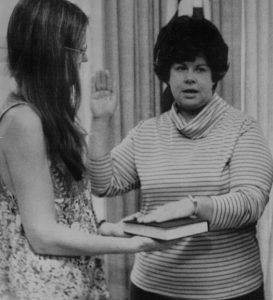
 

Honoring the life of Koryne Horbal

Koryne Horbal takes the oath as U.S. representative to the U.N. Commission on the Status of Women, 1977. Gloria Steinem holds the Bible.

This past May, Minnesotans mourned the passing of Koryne Horbal. In her lifetime, Horbal launched the Minnesota Women’s Political Caucus and the DFL Feminist Caucus, served as a U.S. representative to the United Nations Commission on the Status of Women, and听was appointed the DFL party chair at the age of 31.听A vocal and unapologetic activist, Horbal was a champion for women, as well as the LGBTQ+ community. Neither the loss of her husband in 2015 nor the three strokes she subsequently suffered stopped her听from working on the 2016 presidential campaign for Hillary Clinton. Horbal did not have the money to听attend college in the 1950s, but 海角社区 granted her an honorary degree in 2008 due to her work as a consultant with Augsburg’s Women’s Resources Center. Koryne Horbal lives on through her children, grandchildren, and the feminist spark that she ignited in people around the world.

You can.

Mike Sime talks with Paul Douglas on WCCO Radio about the start and success of the 厂迟别辫鲍笔庐 program.

Mike Sime, Augsburg 厂迟别辫鲍笔庐 program advisory board chair, talked with Paul Douglas on WCCO Radio Friday about the program’s foundation, success, and work to support other institutions in establishing recovery programs. Douglas called 厂迟别辫鲍笔庐 a revolutionary program, as it currently is the largest听residential听collegian听recovery program in the U.S. The program is dedicated to听students听in recovery from drug of alcohol abuse and provides a sober听living听environment听and听counseling.

“I look at it as a parent. If you have a听student听who is newly in recovery, has been sober and now you think about sending them off to college, that听would听be my worst nightmare, so to have a safe and supportive environment that they can come to that is clean and sober with other students, it really makes sense and creates an unique听environment,鈥 expressed Mike about the importance of having such program.

The program began after a student in recovery shared听his听need for a sober environment, explained Mike. The student expressed that his experience would have been easier if he had a community who was also in recovery with him. Augsburg made the commitment to develop 厂迟别辫鲍笔庐听and through it, the program has helped over 750 students in 20 years.


Listen to the full story beginning at 16:40 on the听Paul and Jordana Show website.

Brian Krohn Creates a Cell Phone Application to Combat Snoring

Photo: Glen Stubbe, Star Tribune.

Star Tribune’s Richard Chin refers to Brian Krohn 鈥08听 as a 鈥淢innesota Genius鈥 in his article. Among Krohn鈥檚 creations are surgery tools,wizard staffs, a cycling workout app, and more recently, Soundly, a cell phone application designed to help people who snore by getting them to play a voice-activated game to strengthen their upper airway muscles.

While at Augsburg, Krohn switched majors from film to chemistry, that鈥檚 when his interest in becoming a scientist began. His undergraduate research led him to 鈥淕ood Morning America鈥 where he talked about a process to produce environmentally-friendly fuel, which was later commercialized in the development of a $9 million pilot plant.

鈥淎 lot of times I get a little bug about something, I kind of just do things and see where they go,鈥 says Krohn about his ventures.

Midwest Home talks with Professor Kristin Anderson about “ordinary” mid-century homes

Kristin Anderson in stadium
Professor Kristen Anderson

Midwest Home Magazine featured a Q & A with Kristin Anderson, professor of art history and 海角社区 archivist, about her presentation,听“Residential Architecture of the 1950s and 60s,” which focuses on ordinary homes from the period.

Anderson developed the presentation after she encountered strong interest in her continuing education class for real estate agents from people outside the real estate industry.

National recognition for Augsburg’s StepUP recovery program

Nationally, it is estimated that 30 percent of college students are battling substance-use disorders. Colleges and universities are asking听what role they can play in helping their students stay sober. is a national leader in the field, with substance-free dorms and counselors available on site. For 20 years, StepUP has welcomed students in recovery, and continues to support those fighting addiction and seeking their degree.

 

The tremendous work of StepUP has been featured in the Chicago Tribune,听, and

Matthew Demond speaks at Augsburg about his Pulitzer prize-winning book, 鈥淓victed.鈥

Photo by Greta Kaul – MinnPost

Housing prices are going up, and so are the number of evictions in the Twin Cities. Evictions are specially affecting some of the most disadvantaged populations. Matthew Demond, professor at Princeton University, spoke at 海角社区 about his Pulitzer prize-winning book, 鈥淓victed: Poverty and Profit in the American City鈥. In this book, he follows eight families in Milwaukee and documents their struggle to keep a roof over their heads.

鈥淥ftentimes evictions aren’t a condition of poverty, they’re a cause of it. In the Midwest, with cold winters, evictions spike in the summer because many people who struggle to pay for housing expenses pay their landlords in the winter, when utilities companies are banned from shutting off the gas, and switch to paying the utility company in the summer鈥, Desmond explained to a packed house at 海角社区.

History Professor Michael Lansing Discusses the Beginnings of Processed Food in America

WUNC 91.5 radio station logoIn a conversation with radio host Frank Stasio, Michael Lansing, history professor and chair of the history department at 海角社区, explores the beginnings of processed food in America. Lansing takes a step back to the 1870鈥檚, the root of the industrial food take off in the diet of Americans.

He identified processed meat, canned food, and carbohydrates as the three primary sectors in this new diet. Lansing touched on some factors that affected the change of diets, declaring that intensive marketing campaigns convinced consumers to believe industrial food was better for their lifestyle. Cheap railroad transportation and the negotiations made by mass producers allowed them to sell at a cheaper price than local makers. In the early 20th century, more people began to move from rural to urban areas, which reduced the opportunity to farm their own food, making industrial food more reliable, explains Lansing.