MPR News and Sahan Journal recently highlighted Nia-Symonne Gayle 鈥�24 and her senior exhibition project 鈥淕OOD Hair,鈥� currently displayed in the Christensen Gallery through February 19. Gayle graduated as an art and design major in December, and her capstone project recreates her childhood living room where her mom would do her hair鈥攊ncluding TV, magazines, and hair products associated with the Afro-nostalgia Gayle incorporates into her work. She says this project 鈥渋s a love letter to her mother and to Black people and Black culture. It鈥檚 a reminder that all hair is good hair.鈥澛犅�
Read more about the project from or and learn more about Augsburg鈥檚 .
Program Director Keri Clifton (second from left) smiles with participants from the first Community Practice Cohort.
The Reell Office of Seeing Things Whole (STW) at 海角社区 empowers leaders to positively impact their personal and professional communities. One avenue of empowerment is the Community Practice Cohort鈥攁n opportunity for anyone who wants to enhance their leadership skills and gain insights around real-life leadership challenges.听
鈥淥ur inaugural cohort created opportunities for participants to create action in their real-life leadership opportunities. Seeing the spark of passion emerge from each participant was a joy as they moved through the STW process with a community of supporters. These leaders will continue their impact having gained insight and knowledge that revealed their path forward. I am thrilled to continue this impactful work with the next cohort,鈥� Program Director Keri Clifton said.
The second Community Practice Cohort is accepting eight members to embark on a 10-month collaborative journey toward effective leadership, starting September 2024. Participants will gain practical skills and knowledge on leadership topics like articulating a problem, communication, team collaboration, and decision making鈥攁s well as personalized roundtables to focus on issues and skills directly related to their organization.
鈥淚 entered into this process in the hopes of exploring new ways to approach challenges I was facing in my current role,鈥� said Michaela Clubb, a national program director and participant in the 2023-24 Community Practice Cohort. 鈥淚 was able to uncover and consider not just the challenge I presented but all of the parts connected to it. I highly recommend this program for anyone who is looking to create intention and impact through their leadership.鈥�
Mentorship is also a crucial part of the Community Practice Cohort, for both the mentors and the participants. The communal learning process brings out the best in everyone and helps create collaborative and innovative solutions to current and future challenges. 鈥淏eing a mentor in the unique Seeing Things Whole program has been my privilege,鈥� said Michael A. Gregory, author, mediation and negotiation consultant, and professional speaker. 鈥淯nlike traditional mentoring, we engage in a two-and-a-half-hour process, listening actively to a leader鈥檚 story without offering advice. Instead, we pose open-ended questions to guide the participant in exploring their identity, purpose, and stewardship. This enlightening process benefits the participant and provides mentors with opportunities to discover new and creative approaches.鈥�
There is still time to apply for the 2024-25 Community Practice Cohort. To learn more about this opportunity, contact Program Director Keri Clifton at cliftonk@augsburg.edu or 612-330-1525.
From left to right: Madelyne Yang, Donovan Holmes, and Tim Pippert
Professor Tim Pippert and Madelyne Yang 鈥�26 were recently interviewed by The Imprint about Augsburg Family Scholars, a program to narrow the opportunity gap for students with foster care backgrounds.
Augsburg Family Scholars builds on Minnesota鈥檚 Fostering Independence Higher Education Grant. This 鈥渓ast dollar鈥� program provides state funding to cover tuition, fees, room and board and other expenses related to the cost of attending college. Pippert told The Imprint that the state grants are 鈥渁 game changer,鈥� but aren鈥檛 enough on their own.听
To bridge the gap, Augsburg Family Scholars supplements the state grant with comprehensive academic and community support. Last year, a dozen Augsburg students participated in the program, which provides help moving to campus, laptops, access to year-round housing, a dedicated lounge space on campus, community outings, and more. Pippert, the Joel Torstenson endowed professor of sociology, directs the program and serves as an advisor to the participants, helping them strategize how to navigate the demands of higher education.听
鈥淚f you鈥檝e made it to college, you鈥檝e overcome so many hurdles already,鈥� he said. 鈥淚f you鈥檝e made it this far, it鈥檚 our responsibility to help students finish the job and get a degree.鈥�
Interfaith America has appointed , El-Hibri chair and executive director of Interfaith at Augsburg, to the inaugural Interfaith Leaders in Higher Education Council. This council serves as a point of connection for educators dedicated to interfaith work both in their respective institutions and throughout the higher education field. The council will meet quarterly with the Interfaith Leadership Institute team to offer their expertise on undergraduate programming and expand their own interfaith leadership skills. 鈥淚鈥檓 profoundly thankful to Interfaith America,鈥� Syeed says. 鈥淲hat an incredible group of leaders to serve and serve with, and a wonderful organization to be a part of.鈥澛�
“Democracy and higher education are inextricably linked in the United States.” This is the central claim of a February 2019 essay, “,” published by the Association of Governing Boards. The lead author of the essay is 海角社区 President Paul C. Pribbenow,聽with editorial assistance from Green Bouzard, administrative program coordinator in Augsburg’s Sabo Center for Democracy and Citizenship.
The publication is part of AGB’s Guardians Initiative, focused on reclaiming the public trust in higher education. To address emergent challenges to democracy鈥攊ncluding political polarization, the devaluation of evidence and truth, and deficient levels of civic engagement鈥攈igher education leaders must understand democracy as a way of life rather than as isolated volunteerism or participation in elections, the article argues.
“A healthy democracy requires engaged citizens, and engaged citizens require preparation and practice,” the essay states. So, while education may be aimed at preparation for careers and professions, the essay affirms that it also must, at the same time, be preparatory for citizenship.
The essay discusses the economic, social, and civic impacts of colleges and universities鈥攃ultivating engaged citizens, serving as community partners, and connecting work with public purpose and community-building in our nation.
In April, Pribbenow will lead a session on this topic at聽AGB‘s National Conference on Trusteeship,聽and in July will lead a session with a select group of university presidents and trustees at a Kettering Foundation event.
The Star Tribune‘s聽Maura Lerner covered Augsburg’s new test-optional admissions policy.
鈥淭he change is designed to level the playing field for those without the money or time to get private tutors, take prep classes or take the exam multiple times,鈥� said Nate Gorr, interim vice president of Augsburg admissions, in the article. 鈥淚t’s also a recognition that standardized tests don’t always capture a student’s potential, and can discourage good candidates from applying to college.鈥�
Lerner noted that according to the National Center for Fair and Open Testing, many of the 274 test-optional colleges saw an increase in diversity without any loss in academic quality.
Moody鈥檚 Investor Service today revised 海角社区鈥檚 outlook to stable from negative and affirmed the University鈥檚 Baa3 credit rating.
Moody鈥檚 cited Augsburg鈥檚 improved liquidity, effective fiscal oversight, successful fundraising, diverse program offerings, and urban Twin Cities location as strengths supporting its credit opinion. The report also noted that Augsburg continues to operate in a highly competitive student market and has moderately high debt relative to cash and investments.
鈥淭his favorable outcome is a great accomplishment, and one we鈥檝e worked hard to achieve,鈥� said Augsburg President Paul C. Pribbenow. 鈥淚t鈥檚 a reflection of Augsburg鈥檚 competitive strengths — including our distinct market identity and diverse enrollment — as well as our intentional, sustained efforts driving dramatic improvements in liquidity.鈥�
Following the mid-December announcement that McNally Smith College of Music would be closing this December, 海角社区 teams have swung into action to support McNally Smith students seeking to transfer in order to complete their degrees.
Recognizing the urgency many McNally Smith students, including international students, are facing, Augsburg will enroll transfer students as quickly as this spring semester, which begins January 8.
“We will do our very best to assist students through this process as quickly as possible,” said 海角社区 Registrar Crystal Comer.
Augsburg and McNally Smith have an existing articulation agreement — a formal agreement that establishes transfer policies for specific courses or programs. Augsburg also is committed to carefully reviewing students’ courses that are not included in the articulation agreement for possible credit transfers.
Augsburg staff will be on site at McNally Smith this week to help student understand their options. McNally Smith students also are encouraged to schedule an appointment with a transfer counselor at Augsburg via the web site:聽.
According to Augsburg Interim Vice President of Enrollment Management Nate Gorr, many McNally Smith students have already scheduled appointments. Students also can call or email questions to the Augsburg transfer team at聽transfer@augsburg.edu聽or 612-330-1001.
“People from across Augsburg — including聽faculty, academic advisors, admissions and housing staff, the registrar’s team, and student affairs — immediately began working to see how we could help McNally Smith transfer students when the announcement was made last week,” said 海角社区 President Paul Pribbenow. “Our hope is that our efforts and those of our sister schools will support all of McNally Smith’s remaining students in accomplishing their educational goals.”
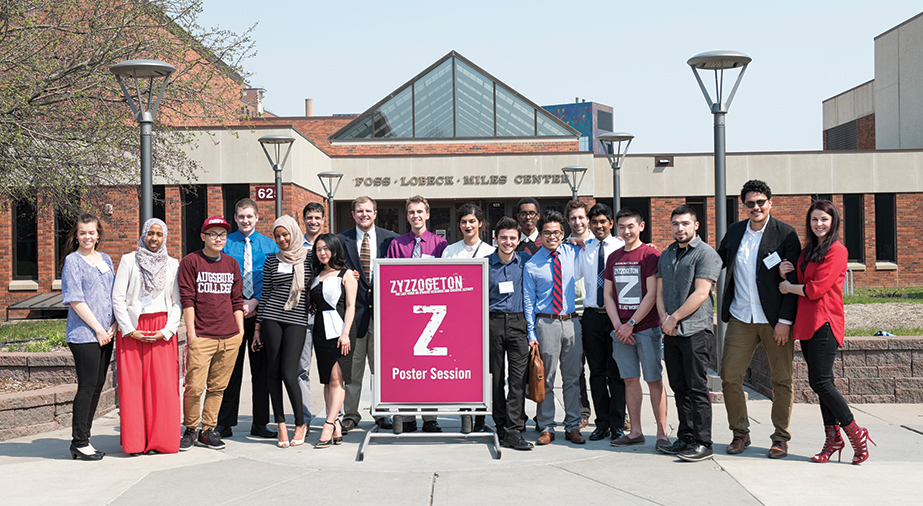
The AugSTEM Scholars Program, funded through a grant from the National Science Foundation, supports students pursuing degrees in science, technology, engineering, and math (STEM). The scholars participated in Zyzzogeton, a celebration of student research.
The National Science Foundation awarded Augsburg College a highly聽competitive $1 million grant for continued support of the AugSTEM聽Scholars Program. Under the direction of Professor聽Rebekah Dupont,聽the program will provide scholarships to as many as 80 academically聽talented students with financial need who are pursuing studies in science,聽technology, engineering, and math.
The four-year grant is part of NSF鈥檚 work to address the need for a high-quality, diverse workforce. With a traditional undergraduate student body聽that is more than 35 percent persons of color, Augsburg is well positioned聽to support this goal. The program provides direct financial support, delivers聽hands-on learning, offers research opportunities, and pairs each student聽with a faculty mentor. Research shows this combination of hands-on聽learning and close mentorship is highly effective in helping students leave聽college ready for graduate school and the workplace.
Editor鈥檚 Note: This material is based upon work supported by the National Science Foundation under Grants No. 1565060 and 1154096. Any opinions, findings, and conclusions or recommendations expressed in this material are those of the author(s) and do not necessarily reflect the views of the National Science Foundation.

 MPR News and Sahan Journal recently highlighted Nia-Symonne Gayle 鈥�24 and her senior exhibition project 鈥淕OOD Hair,鈥� currently displayed in the Christensen Gallery through February 19. Gayle graduated as an art and design major in December, and her capstone project recreates her childhood living room where her mom would do her hair鈥攊ncluding TV, magazines, and hair products associated with the Afro-nostalgia Gayle incorporates into her work. She says this project 鈥渋s a love letter to her mother and to Black people and Black culture. It鈥檚 a reminder that all hair is good hair.鈥澛犅�