
Our journey聽has been defined by the serpentine path of the Mississippi as it carves its way through the middle of the country. As a feature of our geography, it has facilitated a particular path through the world. 聽In our canoes, we stick to the main channel, and the charts or the river tell us how to navigate and avoid the rocks and submerged stumps. 聽But our trip has also been through a human landscape–the chain of communities, towns, and social networks through which we have moved as we head toward the sea. 聽It is a rich and varied set of communities, and I noted earlier some aspects of “river culture”–the sense of generosity, a certain wildness, and shared connection to the rhythms and flows of the river. 聽But as our trip winds down, one of the most salient aspects of this human geography聽has been its racial聽segregation. 聽In聽exploring “democracy in America” today, we were repeatedly struck by the fact that we do not live in a post-racial society. 聽This shouldn’t come as a surprise, but nonetheless, spending 100 days slowly meandering the breadth of the lower forty-eight has certainly affirmed the ongoing importance of race (and class and gender) as socially significant categories.聽This manifested in various ways throughout our trip.
To begin with our聽group (in 2015) itself was comprised of聽people descended from immigrants from England and Germany, Scandinavia, Italy, and the like. I had originally hoped to have a group of students who would reflect the diversity of Augsburg and the Twin Cities, and there was interest from a wide range of students on campus. 聽But in the end, for a trip of this nature (long, expensive, camping), those that ended up being able to go were white. 聽We come from families that had taken us聽camping, or at least traveled; our families聽have the financial means; we have the support networks needed to be on the road for four months; and we聽saw this as an exciting and fun way to get a college education. 聽For any of the students of color who were at least slightly interested, one or the other of these conditions were not met. (Note: in 2018, thanks to a variety of factors, there were almost 50% students of color on the trip.聽 See blog post on 2018 expedition.)
This may have been slightly disappointing, a missed opportunity. 聽Diversity in the classroom and on campus enriches everyone’s experiences so much, and I really wanted to create an opportunity that would be accessible to anyone interested in going. 聽But there was a more troubling aspect of the trip–with rare exception our group moved through a white world, meaning that almost all our substantive interactions have been with people of European descent. 聽As water seeks the path of least resistance as it moves towards the sea, our path of least resistance through the human landscape聽has been through those networks of people with whom we shared most ties and affinity. 聽In setting up the trip, trying to contact people to meet with, and partner organizations, my list of connections was predominantly white (and male, but that’s another story). 聽Not that I sought any of this, but that was who ended up on my list. 聽Any time I asked someone who we should meet with, or looked online for a local expert, I found whites. 聽In the boats on the river (whether through-paddlers, towboat crews, or pleasure boaters) it was whites; in the houses and towns along the river it was whites. 聽Here and there we saw some people of color: 聽Latino farm workers or an occasional African-American on the shore fishing. 聽When I tried to set up meetings or visits in communities of color–in Ferguson or at the Prairie Island Reservation–I couldn’t find anyone to contact, or the people I tried to contact didn’t reply. 聽The lead I had for聽visiting Ferguson was a white photojournalist who had shot the photos during the protests and riots there. 聽In the Lower Ninth Ward, our bike tour guide did live in the neighborhood, but he was white and a recent transplant to the area.
We live in a society and country in which聽there are聽parallel worlds separated by invisible walls; we paddle a white river, and somewhere on the other side of an invisible partition are different rivers. 聽There are聽people of all ethnicities and countries of origin along the river, and that diversity is increasing, but it is as if they move in different universes. 聽In many cases, as Michelle Alexander has pointed out so powerfully in her The New Jim Crow, the walls (and bars) are very real. 聽But part of the “new Jim Crow” is spacial as well. In other cases the separation is聽created by the lack of social interconnections between the different races and ethnicities that could be described, in contrast with institutional racism, as “spacial racism.” 聽As the “war on drugs” becomes a “race-neutral” way to imprison thousands of young black men, the higher levels of mobility on the part of the wealthy, becomes a “race neutral” was to maintain a highly segregated society. 聽There was been plenty said about this in terms of housing patterns and school segregation, but it is always another thing to experience it so powerfully first hand, as we traversed the country from near the Canadian border, all the way to the sea. 聽Regardless of intentionality, our lived spaces and social networks remain racially segregated (with some exceptions that I’ll discuss further below). 聽This was the second feature of our experience of race on the trip. 聽The third was a shift in the kinds of racial attitudes we encountered as we traveled south.
At various points along the way, we encountered examples of whites who either had chosen to separate themselves from the diversity of the city, or expressed some openly prejudicial views. 聽The further south we got, the more extreme those views became. 聽There was, for instance, the mother who moved from New Orleans to small-town Minnesota, enamored of the Laura Ingalls Wilder stories and聽the pioneer mythos, and troubled by the violence and unrest she experienced in the south; she did not want to raise her children in New Orleans, and sought a context in which the mythic life of Ma and Pa Ingalls prevailed–even if it was mostly a myth. 聽The constant moving of the Ingalls family itself could be read as, in part, a very early example of white flight (whenever things got too crowded, Pa would want to move further out into the wilderness). 聽Here there was no overt expression of racial bias or prejudice, but the all-too-familiar act of spacial segregation. 聽Mobility has always been a powerful vehicle for racial and class-based segregation. 聽Those with the means have been able to leave; those without are stuck. 聽Our mobility along the river was a manifestation of our white privilege as well. 聽All along the river we noticed the spacial segregation in terms of socio-economic status. 聽On the high ground were always the nicest houses (often palatial mansions), and the closer you got to the mud and flooding of the river, the more marginal the housing. 聽This was true from the Twin Cities all the way to New Orleans and out into the disappearing bayou country.
A little further south, the manifestations聽of prejudice became more overt. 聽One evening, I hung out at a bar at a hotel in Alton, Illinois. 聽Bars are often a good place to get a feel for a place, with alcohol often thinning the veneer聽of social proprieties. 聽There was a group of about a dozen聽white guys in their 60s,聽laughing raucously and talking in loud voices about golf, strip clubs, homes in Flagstaff, fast cars, and referring to anyone who stingy as a “Jew” (and singing “Hava Negila” to emphasize the point.) 聽They were having the time of their lives, really yucking it up. 聽I was struck by the contrast between that groups’ realities and that of the African-American cook at the “custom-made omelettes” station at the hotel I saw the next morning. He聽seemed to bear the weight of endless hours of labor on his shoulders; labor that would not lead to fast cars, or houses in Flagstaff, or to raucous reunions with high school buddies. 聽These men moved in different worlds, worlds shaped by structures of opportunity and constraint that would lead their lives in very different directions. 聽The rules stacked in favor of those who “won the war,” so to speak; to the victor go the spoils–for them the hard work pays off; for those in that parallel, black, universe, the hard work much less often聽does. 聽Because unfortunately, to a large degree, the distribution of economic resources in a community聽is a zero-sum game. 聽The money accumulated by the few can only come from the many. (Yes, the economy can grow and the pie can become larger, but far more important is how that pie is divided up, and that division is still largely structured along racial lines.) 聽Robert Putnam’s, Our Kids, focuses on the growing gap between rich and poor and the importance of education in decreasing that gap in opportunities. 聽But the correlation between race and SES is still so strong it seems almost quaint to pretend otherwise (although I can understand the political utility of his approach, making it palatable to a much wider swath of the polis).
In St. Louis, Memphis, and New Orleans, the聽major metropolitan areas, the picture changed abruptly. 聽No longer in the land of Laura Ingalls Wilder, the city was richly diverse. 聽Here, paralleling the confluence of the Mississippi and Missouri Rivers, the two worlds met. 聽Here we finally talked with people of color, but in almost all cases these were with staff, low-paid employees at places like the City Museum, taxi drivers, wait staff, or the musicians in the Big Easy. 聽In urban America–Chicago, St. Louis, New Orleans, New York–black and white聽mix, peacefully coexist, but also聽clash, as seen in the confrontation and riots following the shooting of Michael Brown in Ferguson and the depressingly common examples of this kind of violence. 聽When we arrived in St. Louis and Memphis, I was struck by how many of the whites there聽expressed fear and concern about not going to certain parts of town. 聽Some of this is warranted, I suppose, and a certain level of prudence and common sense is always warranted. 聽But we didn’t have any problems, and it seemed that this palpable聽fear was a big part of what has helped maintain these walls of separation. 聽So much of American politics is driven by fear that, to my mind, just is not supported by the facts (see, for example, Corey Robin, Fear: the History of a Political Idea, or Frank Furedi’s The Politics of Fear). 聽Where the fear seems much more warranted is within the African-American communities, which have experienced domestic terrorism for decades, and for whom encounters with the police are fraught with very real risks. 聽Ta-Nehisi Coates recent Between the World and Me is a poetic and powerful account of that reality.
In the fairly posh neighborhood where I stayed in St. Louis, the owner of the B&B (who was, perhaps needless to say, white), made a point of talking about how he had successfully taken on crime in his neighborhood through a series of neighborhood policing measures and by seeking maximum sentences for any convictions. 聽Neighborhood residents would show up at trial to testify or just be a presence in the courtroom to provide greater pressure to apply harsher sentences. 聽This was referred to as a “Neighborhood ownership model” that consists of citizen patrols (eyes on the street), victim advocacy, a local police office, and stiffer penalties. 聽It reduced crime in the neighborhood, but it also helped reinforce the segregation of the city, and rather than聽get at the root causes of the crime, to my mind, would only help maintain the sense of alienation and economic desperation that feeds the decision to pursue a life of crime. 聽The owners of the B&B had worked very hard to fix up that old house, which was now packed full of old silver and china (one guessed that a good bit of it聽inherited), and they were now working on a second home in Arizona as well. 聽Crime was hurting business and driving down property values, and so the lines had to be drawn. 聽It was hard to blame him for his efforts, but the end result was again a society in which the whites got richer, and the blacks ended up in jail. 聽What would it take to be in a society in which, when I wanted to find a place to stay in St. Louis, I would look up the B&B’s and find one owned by an African-American who was fighting to keep his neighborhood safe from the white criminals? 聽Or better yet, of course, a society in which the opportunities were there for everyone, and thus the incentives to take to a “life of crime” were that much lower.
In St. Louis it felt like we had begun to enter “the South.” The language and demeanor, and demographics, began to shift as we entered territory in which slavery had once been the foundation of the economy. 聽By the time we reached Mississippi and heart of cotton country, this was very much the case. 聽In the hotel in Greenville, Mississippi (not long after a terrorist attack in Paris), four white hunters in camo gear were talking in the lobby about the influx of Muslims into the U.S., and how they were quite certain Obama was getting ready to impose martial law. 聽In loud voices they seemed convinced that the nation’s first black President聽had clearly malevolent intentions and was working in cahoots with Muslim terrorists.
At the southernmost point of our journey, in Chauvin, Louisiana at a local bar, we encountered the usual warmth and hospitality we have in Bayou country, but also ran into a very drunk man, a self-proclaimed fighter, who bragged about being able to kill black people (referred to as “n—-s”) and that he would “probably get away with it.” 聽Being from Chauvin, I guess he could rightly be called a chauvinist. He was unbalanced and full of a kind of pent up energy that I guessed聽came from some deep pain or injury at some point along the line. 聽On some level I think he too was driven by fear. 聽There is certainly a lot of loss, even desperation, in that marginalized edge of the world. 聽There at the end of the line, as deep into the south as one could get, there sat racism and bigotry in its rawest form, and one could easily see a situation in which, if a black man had come into town he might have, like so many thousands before, ended up dead. 聽There is, of course, a great diversity of views, of tolerance, and open-mindedness in people we met in Mississippi and Louisiana, and plenty of racism throughout America. 聽But it was interesting that on our trip at least, the further south we got, the more openly people expressed racist views.
New Orleans is now considering taking down four statues to Confederate war heroes, including the towering monument to Robert E. Lee that sat just outside our聽hotel room on “Lee Circle.” 聽It is a heated debate in the city now, with a petition against that move having recently garnered 31,000 signatures. 聽When students from two Louisiana HBCU’s were in town last week (for the Bayou Bowl) they staged a rally in Jackson Square calling for the removal of the statues. 聽As with the controversy over the Confederate flag, feelings run strong on both sides. 聽But it is time to put those symbols of slavery and oppression into a museum (so we not forget), and not have them stand in public as expressions of our shared values.
All this has made me appreciate all the more the need to actively work to bridge these divides and gaps, find ways to make it easier to interact with people from different backgrounds, experiences, and points of view. 聽For future trips it will be a priority to work harder to reach out and make those connections. 聽We need people whose work and skills help us cross those divides–what we are calling now “intercultural competence.” 聽I so appreciated those people who played that role for us on the trip. When we did manage to break through these walls that tend to separate black and brown from white, we had some of our richest and most rewarding meetings. 聽Schools, like Augsburg聽University, that have succeeded in diversifying their student body are crucial to this process, and we need to continue to work on desegregation of schools, workplaces, and other public institutions. 聽And my hat is off to faculty who have made it a priority to reach across color lines and build bridges between North and South. As but one聽example, my good friend and colleague Jeff Kolnick, who teaches history at Southwest State U. (in Marshall, MN) has down amazing work with the Fannie Lou Hamer Institute in Jackson, MS.
Our first聽bridge-builder we met was in Winona, MN, at the Dakota gathering there. 聽Lyle Rustad, a Vietnam Vet, runs the Diversity Foundation, whose mission is “Bridging the Cultural Gap.” 聽He went out of his way to bring a聽Dakota elder Emmett Eastman to our campsite to share his story with us. 聽It was a raw and unsettling story of historic and personal trauma, resilience, and ongoing struggle. 聽Visiting the Dakota gathering there and sharing a meal with our Dakota brothers and sisters felt like a little taste of the way things should always be.
With Augsburg’s President Paul Pribbenow, we did take our聽trip to Ferguson, MO, and visited the聽site where聽Michael Brown was shot and killed. But without any local contacts we felt聽very uncomfortable and out of place as the only white people there.
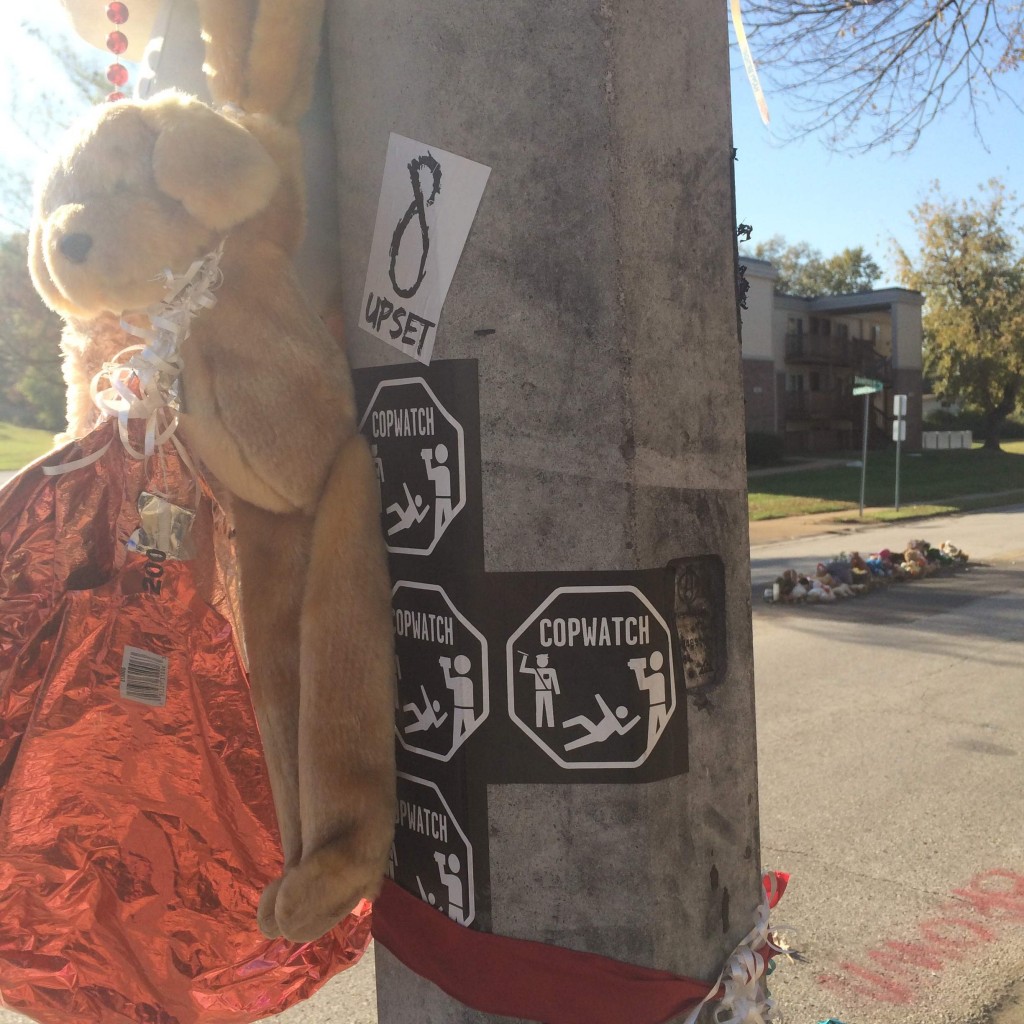
We were the outsiders, those with the means and privilege to be able to visit, and many of our students expressed discomfort with walking through that place. 聽But this made it real. 聽We were able to chat a little with some of the local residents at the burger聽place we went for lunch, and drove to the other side of town where the police station is as well.
In Clarksdale, Mississippi John Ruskey and the crew at the Quapaw Canoe Company have done great work as well in bringing together black and white in Mississippi and taking them out on the river (including us!).
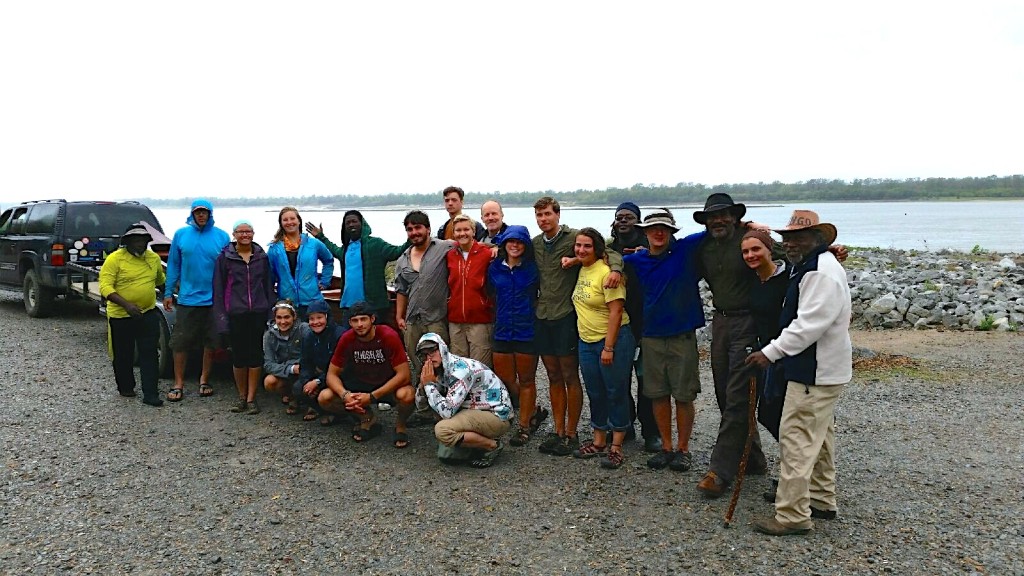
In New Orleans, Nick of “The Confederacy of Cruisers,” took us on a bike tour of the Lower Ninth Ward, where we encountered a community of great resilience; a solid working class neighborhood with 70% owner-occupied homes prior to Katrina, the Lower Ninth is slowly but resolutely rebuilding. 聽We had a great meeting and conversation there with Mr. Lewis of the House of Dance and Feathers, a museum to the culture of the Mardi Gras Indians and Skulls and Bones Krewes.
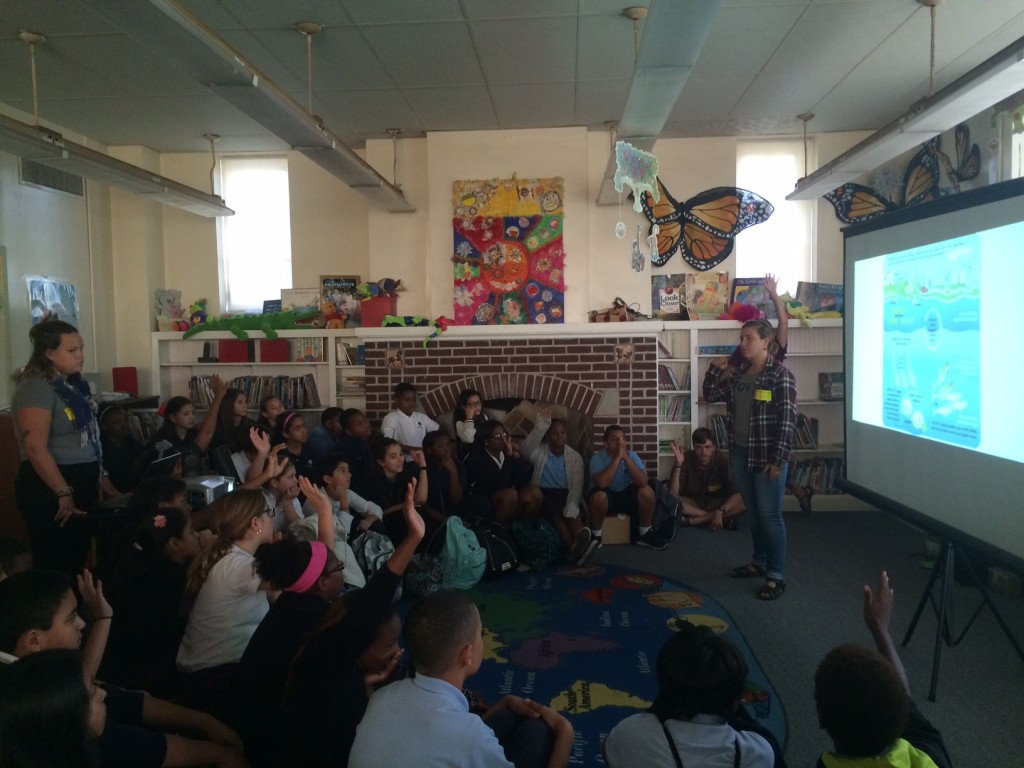
On our 100th day of the expedition, thanks to the persistence of our own Hannah Arvold, and the help of Tracy Fredin of the Center for Global Environmental Education, we met with 4th and 6th graders at International School of Louisiana. 聽It was a beautifully diverse group of kids, at a school with a leaky roof, where our students talked about our trip and shared some of what they’ve learned (from Gulf hypoxia, to hydrophone recordings, to what we ate at camp.) 聽After talking with the teachers there, Hannah decided to聽use the money she had raised to go towards聽some badly-needed lab equipment for the environmental science classes. 聽The students there have been working with the Rivers Institute, getting out onto the water and into local swamps and marshes; perhaps one day some of those students will be able to travel down the river as well and experience some of the beauty and magic that we have on our trip. All-in-all a fitting way to close out our stay in New Orleans, sharing some of what we’ve learned and what we’ve grown to love about the river with some younger students.
The聽arc of history may bend toward justice, but it curves slowly. 聽We have聽a long row to hoe, and we had a long way to the travel the length of the Mississippi River.聽 But with each swing of the hoe we make a little progress, and each time we dip our paddle into the river, lean back and pull the water back, we move a little closer to the sea.