
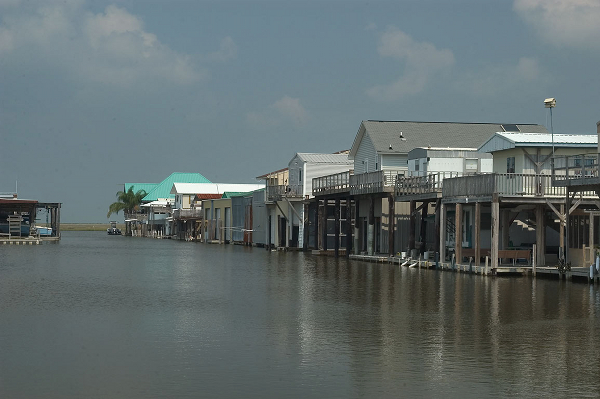
Cocodrie sits at the end of Louisiana’s Route 56, about two hours south of New Orleans on Terrebonne Bay. 聽It’s name is the Cajun word for alligator (crocodile being the closest thing they had for those fabulous reptiles). 聽But there are no “cocodries” or alligators here any more. 聽In fact, there almost isn’t any Cocodrie at all. 聽It sits in an area where land is disappearing at an alarming rate. 聽Alligators are fresh water creatures, and here the water is distinctly salty. 聽Now the local “charismatic megafauna” is the bottlenose dolphin. 聽The community started out as farmland for the Acadian refugees; over time it shifted to fishing; now it is mostly temporary fishing “camps” hoisted up on the 20-foot pilings pictured above. 聽Carl, the Cajun captain of the research vessel we went out in, recounted driving out to the barrier islands with his father (in a car, that is). 聽Today, it took us an hour in a fast boat to get to the one remaining remnant of barrier island left, and that island’s days are numbered. 聽At the Louisiana Marine Consortium () in Cocodrie, where we are staying this week, we learned that their 50-year plan is, and I kid you not, to be under water. 聽That would certainly make them an authentically marine consortium.
The coast here is dissolving into the sea, primarily because of three聽things: 聽the fact that all the sediment coming down the Mississippi is funneled far out to sea between the high levees of the navigation channels, rising sea levels (and coastal subsidence), and because of the maze of channels cut into the bayous by the oil companies. 聽The maze of interconnections here between our use of fossil fuels, our desire to control and channel the river, and our modern industrial economy are complex and far-reaching indeed. Paul Tidwell’s Bayou Farewell, chronicles this process vividly (and is well worth reading). 聽The state of Louisiana has responded slowly, and the people of the Delta are bitter about this fact. 聽Currently Louisiana is building its “Morganza to the Gulf” flood protection wall, pictured here:
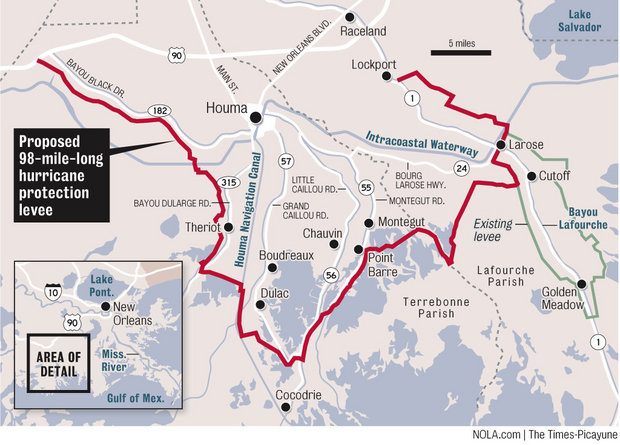
This is the region’s new Maginot Line against the next big hurricane. 聽At present at LUMCON their parking lot floods any time there is a high tide and a south wind of any strength. 聽During Katrina, the winds blew from the north, and they were left temporarily on dry ground. 聽Whenever (and it is a matter of when, not if) they get a hurricane that tracks a little further west, that would mean 150 mph winds from the south, with nothing between them and Venezuela but open water. 聽They are, to put it mildly, in a tenuous position. 聽When Carl took us out to look at the new storm levee, his summation of the effort was blunt and bitter: “They shoulda done this forty years ago.” 聽He is a man whose people have been abandoned by their government. 聽You will note from the map above that Cocodrie (and therefore LUMCON) is outside the line of defense, left to fend for itself. 聽The state is already withdrawing vital services from the area–no fire department, no post office, no schools. 聽Only four families still reside in Cocodrie. 聽聽Forty years earlier the storm protection levee could have been built south of Cocodrie and that community might be able to think about raising children there.
All this brings to mind the ongoing discussion about the seriousness of humanity’s impact on the natural world. 聽We should, by all accounts, be involved聽collectively in the process of what theologians like to call “discernment”– a period of careful, even prayerful, reflection and meditation on the best path forward. 聽Much of what passes for that today is either ignorant denial, outright panic, or a kind of depressed fatalism. 聽In Louisiana, when it comes to coastal land loss, we seem to get a healthy mix of all three.
On our trip down the river though the realities we have seen, smelled, heard, and swam in, are more complicated, hopeful and troubling in various ways. 聽I have been left at times reassured by nature’s resilience and by human determination to steward our resources; at others I have been impressed by the relentless onward push of industry and consumer capitalism. 聽Authors writing about environmental problems often play up the problems. 聽We all like a good story, something that scares us, and a lot of environmental writing tends to fall into that genre (witness my dire account of land loss above). 聽In some cases it is entirely warranted. 聽But on the river, many of the horrors I had expected to encounter did not materialize. 聽The river was much cleaner than we expected, the fish abundant, the restoration projects were showing many signs of success. 聽Yes, many things had changed, and the river had been radically altered by engineering; 聽but, at the same time, nature abhors a vacuum, and in that new river there was plenty of life. 聽Not always the life we would want to see (the silver maple, kudzu, bighead carp, or water hyacinth), but life nonetheless. 聽We were repeatedly surprised by the beauty and wildness we found along the river in places such as the “wild miles” of the lower Mississippi.
One of the stories that originally prompted me to take this trip was John McPhee’s vivid portrayal of the U.S. Army Corps of Engineer’s ongoing efforts to keep the Mississippi River from jumping its banks and flowing down the Atchafalaya basin (which empties into the Gulf just to west of where we are now). 聽His The Control of Nature聽is a compelling tale, full of dramatic floods, impressive figures, and what seems to be impending catastrophe. 聽When we visited the actual “Old River Control Structure,” we found a set of impressive structures to be sure, but little of the sense of imminent disaster implied by McPhee’s account. 聽It is hard for journalists to resist a little hyperbole, and the experience of actually going there is almost always less dramatic than the accounts. 聽This to me is one of the most important things to be gained from experiential education–in James Joyce’s phrase, “the ineluctable modality of the visible” or more simply the inestimable value of first-hand experience. 聽The world has its own truth that no book or account (and God knows, no web site!) can capture, and we are well served by visiting the “real thing” and studying it carefully ourselves.
That said, there is still a real possibility that the Mississippi will, at some point, overwhelm the set of huge walls, dams, locks, and spillways that the Corps has constructed. 聽The whole lower Mississippi has been engineered by the Corps to be able to handle what they call a “Project Design Flood.” 聽This is a scenario in which the flow of the river hits 2.7 million cubic feet per second (cfs). 聽They think they have designed a system that can handle that amount of flow. 聽In 2011, the flow at Vicksburg was 2.3 million cfs (surpassing the amount of the great flood of 1927), and the system was able to handle it with room to spare. But when I asked our tour guide at the site what would happen if there were a flood that exceeded 2.7 million cfs he gave a shrug and said, “well, that’s what insurance and the government is for.” 聽An odd statement coming from a government official working for an agency was to defend the country. By government there, I suppose he meant FEMA and not the Army Corps. 聽If climate change kicks in as predicted (with a hotter atmosphere able to hold and then precipitate more water), they may have to come up with a new plan.
We are far from having achieved anything resembling balance or sustainability on the river. 聽In addition to the land loss in the Delta, the Herculean efforts to keep it flowing past Baton Rouge and New Orleans, Louisiana is also plagued with one of the world’s largest “dead zones,” an area of water largely devoid of marine life because of the huge blooms of phytoplankton that are fed by excess nitrogen fertilizer that flows out of the farm fields of the Midwest and into the Gulf. 聽Upstream we witnessed a bizarre and troubling development that exemplified other聽disconnections between what happens upstream and downstream on the river.
When settlers first landed on the Mississippi they generally had grand plans and hopes for their new communities, giving them names like New Boston and also made frequent reference back to the ancient cities of other great river civilizations, most notably the Nile’s Cairo and Memphis. 聽Through a complicated set of global dynamics, that connection back to Egypt has been realized, although not in the way those earlier settlers had first imagined.
In a strange twist in a very rural corner of southeastern Iowa a huge Egyptian conglomerate is constructing a $2 billion plant to produce fertilizer for the cornfields that stretch out from it in all directions. Orascom Construction International (OCI) is Egypt’s largest multinational corporation, part of the Orascom group founded by Onsi Sawaris. 聽When I was in Egypt in 2011 we could see the huge fertilizer and cement works there, many of which were run by 聽during聽the business-friendly regime of Hosni Mubarek. 聽Reflecting a familiar kind of modern dysfunction, the need for fertilizer in Egypt came about largely because of the damming of the Nile River at Aswan, which cut off the supply of nutrient-rich sediment that would replenish the soil during the annual floods. 聽For millennia these floods were the original source of Egypt’s great prosperity. 聽Now those nutrients must be supplied by the energy-intensive process of creating nitrogen fertilizer in the form of anhydrous ammonia. 聽We saw the tanks of fertilizer scattered across the farm fields in Egypt, and see the same here in the Mississippi River valley.
The plant in Wever, Iowa is located in an old floodplain that, like the Nile, was once fed by periodic flooding of the Mississippi, but is now separated by the levees that line the river almost continuously from the Quad Cities to the Gulf of Mexico. 聽Our contact in Burlington, Steve Brower, mentioned that “Aldo聽Leopold actually recommended the area adjacent to the plant (Green Bay Bottoms) as a wildlife refuge in the early 1930’s when he was聽helping with plans for the IA Conservation Commission (forerunner聽Iowa Planning Board).聽The financing help at the National level fell through.” Financial help for the fertilizer plant, on the other hand, has been more than forthcoming, with the state, county, and local municipalities providing 100’s of millions of dollars in tax incentives to Orascom. 聽The incentives stem largely from the bidding war between states (in this case Illinois and Iowa), the result being a perverse kind of “beggar thy neighbor” policy. 聽Iowa gains a few hundred jobs, but at the of about $1,000,000 in lost tax revenue for each permanent job created.
The process of producing (and using) the ammonia is energy intensive. 聽It uses聽the newly available fracked natural gas as a feed stock, and the fertilizer, once applied on the fields, releases the powerful greenhouse gas nitrous oxide (yes, laughing gas). 聽In addition, the run-off of excess nitrogen from the millions of acres of fields in the Mississippi watershed contribute to a myriad of environmental problems, most notably the hypoxic dead zone in the Gulf about which聽the shrimpers and fisherman of the Louisiana Delta are so acutely aware.
All in all it seems a really misguided and unsustainable way to go. Below the radar (we certainly hadn’t heard anything about this) we are investing billions, incentivized with millions of dollars, in a set of practices that will make both global warming and hypoxic dead zones worse. 聽This to over-produce a commodity that provides cheap feedstock to industrial agricultural processors that crank out a cornucopia of unhealthy foods, mostly laden with high fructose corn syrup (the nutritional equivalent to crack cocaine) that is driving the obesity and diabetes epidemic in this country. 聽We keep building walls and levees, separating ourselves from the river, trying to shelter ourselves from the storms and floods, all the while cutting off the supply of sediment needed to rebuild the coastline and pumping excess nutrients and greenhouse gasses into the atmosphere. 聽Seems we could do a better job of discernment than that.
Thank God that the world and the river are so big, for otherwise it seems we would have used them聽up long ago; and thank God that nature is so vibrant and strong that it so often recovers from our countless assaults upon it. 聽But certainly we can do better. 聽Leave as much of the fossil fuels in the ground as possible (while transitioning as quickly as possible to renewables and greater efficiencies); to a much greater extent, we should get out the聽way of the river and let it do its thing. 聽The river has, for millions of years, worked amazingly well and created habitat and land, providing water, and carrying away waste. 聽If given have a chance to keep doing that, we still have a chance to live along an amazingly beautiful and productive river. 聽Concerted national and international and collective efforts are needed to shift our economy from its present course, and we must patiently and diligently organize and mobilize ourselves to push for these changes at all levels of government. 聽Pick your issue, focus on it, study it, and work on it. On a daily and more personal level, I will take the hard work and simpler life that comes from planting vegetables in the ground, paddling the river, paying attention to the wind and the cycles of the seasons, meeting with the kind and wise people that have gathered by the river, and smelling the pungent wild sage that grows on its banks.