


The River Semester was billed as an experiential learning opportunity: engage in a full load of political, environmental, and physical education courses—reinforced by a research project—while canoeing down the Mississippi River from its headwaters in Minnesota to the Gulf of Mexico.
But for the 12 Augsburg College students, two faculty members, teaching assistant, and two guides who completed the first-of-its-kind trek from August to December, it was so much more.
For it was on those waters that the crew learned to appreciate the quiet, to be curious about the world around them, and to seek knowledge. They learned to be prepared, to make friendship a fine art, and most importantly to enjoy the moment. And they didn’t just learn about the river so much as become enamored of it, so much so that many of them feel unsteady back on solid ground.
The Mississippi became their muse, teacher, personal trainer, and confidante. They dreamt alongside its calming waters and paddled through its more turbulent channels. Soon, its problems became their problems: urban stormwater runoff, the economic decay of river towns, and invasive flying carp smacked them—literally—in the face. And so, what started as an interesting, immersive experience has become a sobering call to restore and protect one of the United States’ most iconic natural wonders.
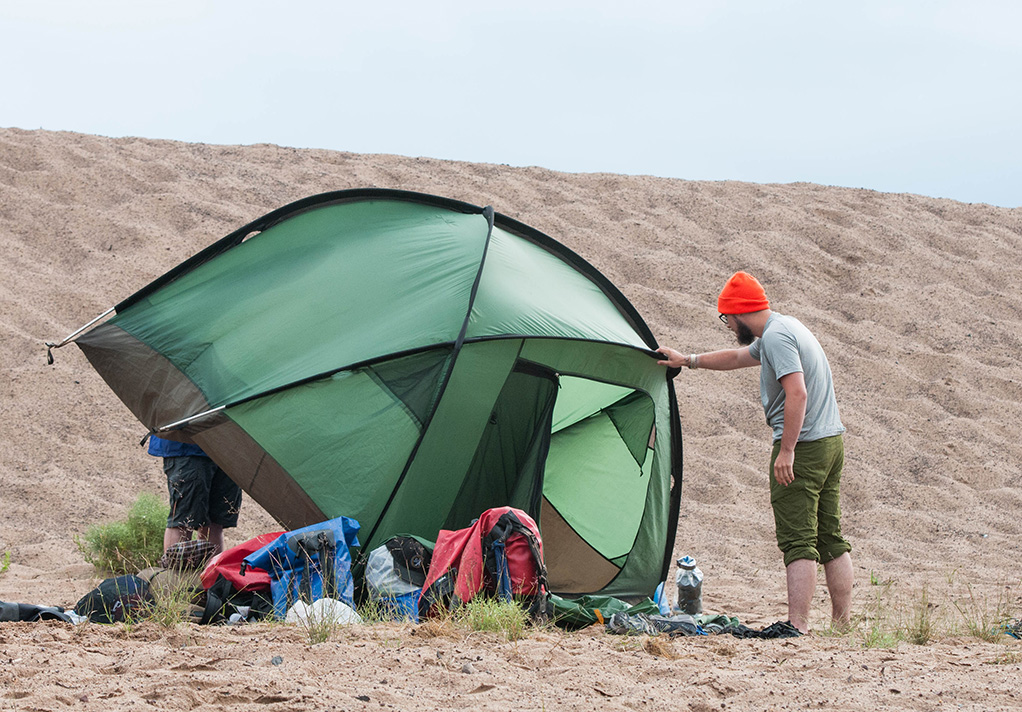 Ricky Taylor ’17, a film and graphic design major, captured the crew’s three-month journey and many of the social, economic, political, and cultural forces gripping the river as he gathered footage for a feature-length documentary. He plans to premiere “Learning to Listen: Our Semester on the River” this summer.
“We learned by living, meeting the people, and witnessing the issues that illustrate the complexities plaguing the river,” Taylor said. “We met Carl, a shrimper who once walked on land that is now six feet beneath water, and we paddled past sediment that was filling in the river’s largest lake (Lake Pepin near Red Wing, Minnesota). We read about levees being ‘big bad wolves’ but then saw them protect families just trying to make their way through life. A portion of Louisiana is being swallowed up by the ocean, a culture disappearing into the Gulf of Mexico, largely due to agricultural practices that help feed our nation.
“Somewhere along the way, I slipped out of the boat and into the Big Muddy. Every day I think about the river—about the paddling, the friends, the food, the learning—longing to be back there. Mud runs through my veins, and the only word I can find to describe the experience is ‘love,’ and that’s not a word I take lightly.”
A gripping odyssey
The trip had all the elements of any good adventure story:
There was a steadfast leader, , who has been engaged in environmental politics for 30 years and had been dreaming about this trip for almost as long; an epic journey paddling nearly 700 miles in 24-foot handmade cedar-strip voyager canoes; and a compelling cast of characters, including the student who’d never camped, the chipper morning person, and a student about to drop out who found his calling en route. There were unexpected moments, including an emergency appendectomy outside Mark Twain’s hometown, an open mic night harmonizing with the locals of Prairie du Chien, Wisconsin, and a visit to the Michael Brown memorial in Ferguson, Missouri. And finally, there were lots of emotions—all of them, really.
Underhill knew the trip would be an odyssey in every sense of the word. The professor of political science, environmental studies, and international relations had been planning and networking for 15 years to realize the River Semester. He tested the waters in 2001 by organizing a three-day field trip from St. Cloud, Minnesota, to St. Paul. Five-day and 10-day excursions followed before he proposed the semester experience in 2012.
“This is where Augsburg stands out from other institutions,” said Underhill, who has organized interdisciplinary trips throughout the world. “Augsburg values experiential learning, place-based pedagogy, and innovative approaches so much that it wasn’t a matter of ‘if’ we can make this happen but ‘how.’ Yes, we had three years of sorting out logistics, but the College continues to empower and support faculty to engage in this type of work, and you only have to talk with one of these students to grasp the impact.”
Once logistics were in place, Underhill’s years of contacts at organizations such as the National Park Service rushed in to participate—offering guest lectures, exclusive tours of historic sites, hot meals, and lodging. Wilderness Inquiry, a Minneapolis-based outfitter that has partnered with Augsburg for years, provided logistical expertise and risk management planning as well as guides, food, and equipment. Erik Ophaug, a Wilderness Inquiry program manager, said the outfitter is proud to be at the forefront in creative endeavors that increase students’ access to and connection with the natural world.
“This was the longest expedition we have run, in terms of number of days on the river, in our 40-year history of supporting educational and expeditionary outdoor adventures,” Ophaug said. “It was inspiring to watch these students truly soak up and process all of the little moments that make up the culture, politics, ecosystem, and history of the Mississippi River watershed.”
Guide Emily Knudson ’15 had paddled with Underhill on a 10-day canoe trip as part of a River Politics course her senior year. When she learned the semester-long excursion wouldn’t materialize until after she would graduate, the determined triple major in environmental studies, English literature, and Spanish secured a job with Wilderness Inquiry in hopes of gaining a staff position on the trip, which she did. Charged with almost every logistical task, from planning mileage and booking campsites to grocery shopping and monitoring weather conditions, Knudson also served as a supplemental instructor and intern for Augsburg. She led study sessions and presented lectures in their outdoor classrooms (or the nearest city’s laundromat or public library in bad weather).
“Educational experiences like this are important because they make you think so much more deeply about the course content. Instead of memorizing facts about the lock and dam system for a test, we were paddling through the pools the dams created, hearing stories from locals, and camping on the islands built to replace those flooded out decades earlier. In a couple years, I will forget almost everything I memorized, but I will never forget my learning in action,” said Knudson.
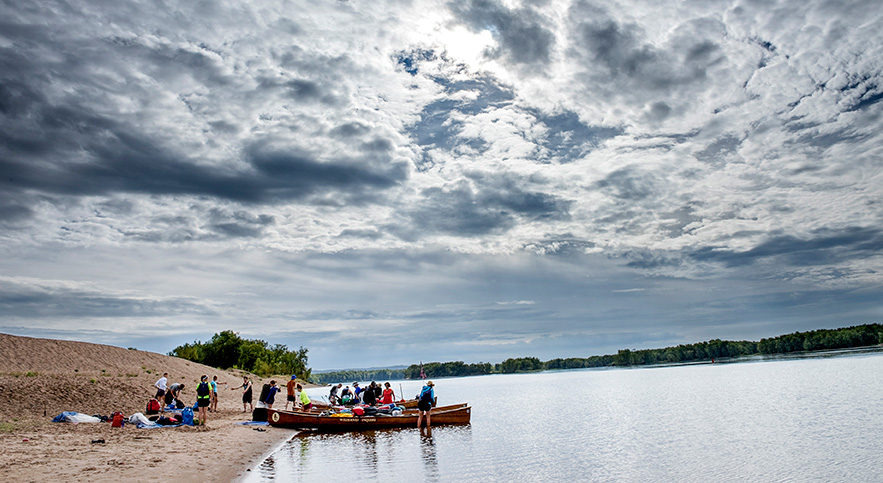
Self-discovery on the riverbanks
Glen Gardner ’17 was considering taking a year off from school when he saw the River Semester publicized in the cafeteria. He signed up, and somewhere along the pilgrimage, the Montana native realized he wants to teach art. Gardner is back at Augsburg this semester, majoring in studio art and art education.
“Having the time to unplug and reflect about my life helped me realize my passion for art education. I have always been interested in the arts, but I hadn’t really thought about teaching until I discovered that I loved spreading the feelings I find in art to other people as much as I enjoy making art,” Gardner said. “I want to extend my knowledge and passion beyond myself and use art to promote living in a way that is not wasteful to the world.”
Hearing this, Underhill is proud. Provoking self-exploration was not his motivation for organizing the trip, but the sense of vocation students found down river is certainly the journey’s most fulfilling outcome. Admittedly, he took a leap of faith selecting the crew. He didn’t pick a team of students with similar interests, backgrounds, maturity levels, and outdoor experience. He picked a team that reflects Augsburg’s commitment to nurturing a diverse community of resilient, driven, and faith-filled citizens. As you can imagine, the initial weeks included some whining and a few cold stares, but before long, this dynamic group evolved into a harmonious tribe.
Forging lasting bonds
Taylor was nervous about the trip, not because of the physical demands or the elements (he was an Eagle Scout and grew up a “river kid” in north-central Wisconsin). As the crew’s videographer and documentarian, Taylor was most concerned about getting his new Nikon, Sony video camera, and two GoPros wet. But even more so, he was terrified of the quiet—for those moments when people would start sharing information about their lives. He was finishing up his second semester at Augsburg in the College’s , the nation’s largest residential collegiate recovery community.
Now sober for two years, Taylor said he burned bridges between himself and others before he entered recovery. “My peers on the River Semester were some of my first friends in a long time. It was truly a fresh start,” he said.
“On the trip, I heard things that were strange to my ears: ‘Ricky, you’re a good person,’ ‘You’re kind,’ and ‘I’m amazed by you.’ I always looked around, thinking, ‘Are you sure you’re talking to me?’ It was the first time in years that I felt good, felt worth, and felt confidence. People trusting and caring for me is more precious to me than anything, and I developed everlasting bonds with this crew.”
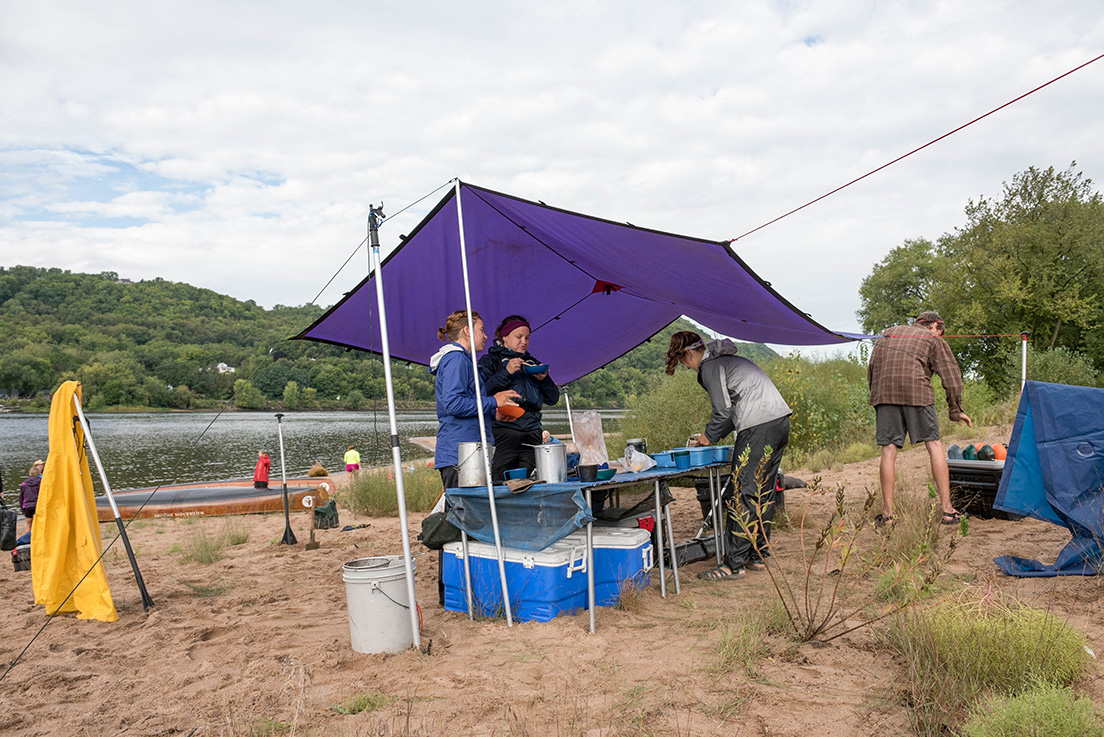 Brian Arvold ’80 witnessed that closeness when he welcomed home his daughter, Hannah, who was one of the first two students to sign up for the trip. When the crew stepped off the train at a welcome home rally in mid-December, Arvold said, the students ran into their families’ arms, and then they all ran back—to each other.
“It was touching for all of us to see,” said Arvold, who was waving a canoe paddle painted with “River Semester” as the train slowed to a halt. “You may want a lot for your child, but lifelong friendships are at the top of the list. Knowing that these students will be there for each other through life’s ups and downs is comforting.
“We’d talk to Hannah along the trip, and we could hear her growing more socially and culturally aware, but we also detected a real sense of confidence. Paddling that entire river empowered our daughter as she was placed in settings where she had to stand up for herself, push through, and create solutions. Augsburg is truly on the forefront—a small college doing great things. It’s neat to see them embrace learning without four walls.”
Living and learning on the river
The outdoor classroom developed into one of the excursion’s top challenges. Underhill and fellow organizers put a lot of thought into how to best maximize the lecture and classroom portions of the semester while maintaining efficient mileage and travel down river. The team pushed off with a mix of short, medium, and long paddling days that corresponded with short, medium, or long days of lecture and class at campsites, historical points of interest, and local libraries. But within the first few weeks, the team realized that loading and unloading educational gear from the canoes each day cut into class and travel time.
“To give students a break and free up more time for class, we shifted paddling itineraries to canoe two or three very long paddle days in a row, and then have several days in a row off for school,” Underhill said. “This greatly enhanced and focused learning potential so that the group could take advantage of as many experiential opportunities as possible while on the river, and on the off days, maximize reading, lecture, and project work.”
It quickly became clear that the professor had to be protective of time. Friendly community members invited participants into towns for hot meals and enriching experiences. But although they padded their days for unexpected events and impromptu outings, the practical realities of their journey—setting up camp before dark and approaching storms, for instance—required a tight schedule.
“We enjoyed an embarrassment of riches in terms of learning opportunities along the way,” Underhill said. “People would show up and want to talk to us or invite us to partake in amazing cultural, historical, or entertaining events, but we had to fit in hours of education on top of paddling five to eight hours each day. That resulted in some tough choices.”
Underhill and his faculty colleague for the trip Thorpe Halloran, an instructor of fisheries biology and stream ecology, often held classes on the banks under sturdy trees, students swatting at mosquitoes while typing on laptops pulled from waterproof bags. But the professors rarely passed a teachable moment, even between strokes. Hannah Arvold ’18 recalls paddling past colorful boathouse communities near the main channel when conversation veered into the regulation of river towns.
“This experience helped me to decide to pursue a degree in environmental studies,” she said. “It helped me realize my interest in food justice, sustainability, and environmentally conscious agriculture practices.”
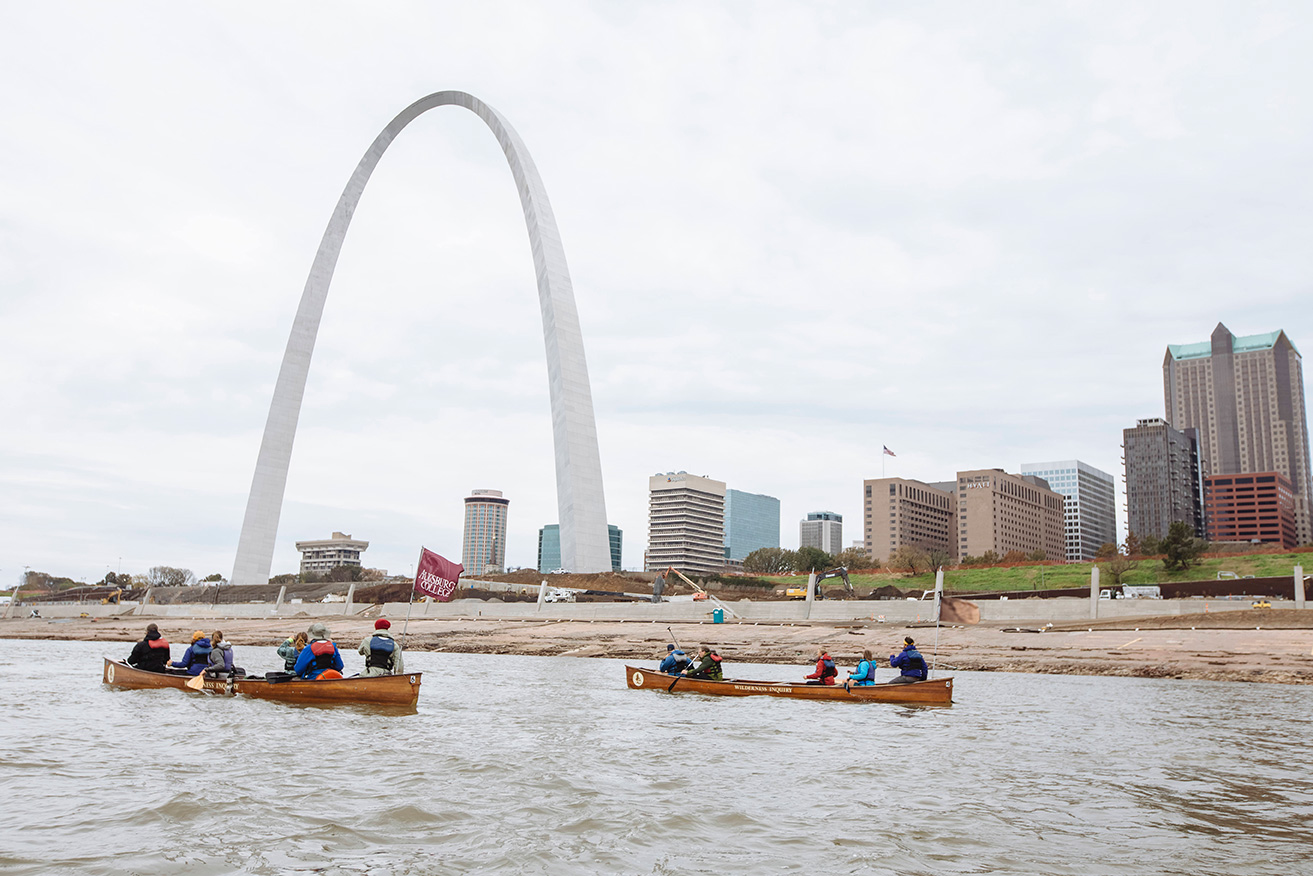
Wading through analysis, navigating partnerships
Arvold was able to channel her professional pursuits into a research project focused on nutrition and the environmental impacts of farming. On the first leg of their trip, she calculated the caloric intake and expenditure of her peers, noting which foods provided the best sources of energy. Near the end of their voyage, she recorded the agriculture industry’s negative impacts on the river, including gasoline and pesticides seeping into groundwater. “Caring about the health of your body,” Arvold said, “is just as important as the health of the land it is grown on.
“I created an ‘I ♥ the Mississippi’ bumper sticker and gave it out to people along our trip for freewill donations,” Arvold said. “We donated $500 of the money raised to purchase science equipment for the International School of Louisiana where we presented many of our research findings to more than 160 fourth- and sixth-graders.”
Each student conducted a research project, and many of them involved collaborations with external partners throughout the United States. Noah Cameron ’17 worked with Minnesota artist Monica Haller, known for the “Veterans Book Project,” which captures interviews and data from dozens of soldiers, refugees, and journalists affected by wars in Iraq and Afghanistan. Cameron used a hydrophone to record underwater noises while on the river and then paired them with social and cultural recordings, which he plans to use for future collaborations with Haller.
“It seems that intense, mindful listening is a difficult task nowadays, and some people have no reason to listen. I was given a reason, and I learned much about the nature of sound, silence, noise, and listening,” the political science major said. “My project acknowledges that the river has something to say, which it certainly does. One thing the river told me was that it is polarized; its waters are either filled with the sounds of mechanical engineering or with quiet ecological or hydrologic characteristics.
“Similarly to how I thoughtfully listen to the systems of the river, I realized that we—as a society—should thoughtfully listen, which is not the same as agreeing, to our government and each other. I viewed the river like our government—this massive, daunting entity that we seem to have little effect on. However, as we moved down that river and as we took classes about both the nature of the river and the nature of democracy, we learned that we do affect that river, and we do affect our government.”
Blair Stewig ’18 connected with the river on a molecular level, studying how the concentrations of various chemicals influence ecosystems. Throughout the trip, she collected water quality data like that of the National Park Service’s “State of the River Report.” She also collaborated with Reuben Heine, a geology professor at Augustana College in Rock Island, Illinois, to gather sonar data about subaqueous dunes, or sediment bed forms at the bottom of the river.
“My main focus was on the accumulation of nitrates in the Mississippi and its effect on the Gulf of Mexico. The molecule, commonly found in fertilizers, seeps into the river system from agricultural and urban runoff, feedlots, sewage treatment plants, and more. This excess results in a ‘Dead Zone’ in the Northern Gulf of Mexico each late spring and summer,” said Stewig, who is majoring in biology and chemistry. “What does that mean? An influx of nutrients results in an algae bloom. When these algae die, they sink to the bottom of the ocean, where they are consumed by bacteria, which depletes the area of oxygen. Some marine life sense the lack of oxygen and leave, but others die as a result. According to the National Oceanic and Atmospheric Administration, the Dead Zone costs the U.S. seafood and tourism industry $82 million per year.”
Lark Weller, who collaborated with Stewig on behalf of the National Park Service, said Stewig’s data will inform brochures and fact sheets about excess nitrates in a river system that provides water for upwards of 15 million people. The research these students conducted is compelling, Weller said, but their connection to the river is even more impressive.
“I suppose it’s possible to complete a college degree without really ever understanding the broader context of the world around you—but not for River Semester students. It is clear the experience dramatically changed the lives of every single student who accepted the challenge. They have returned with a new and expansive sense of self, place, and world,” said Weller.
Lily Moloney '15
“Being warm at night made a world of difference, so I couldn’t have lived without my sleeping bag.” —Lily Moloney
Hannah Arvold '18
“We learned to survive with pretty much nothing, but I was so thankful for my wool socks on the cool mornings paddling and when nights began to get chilly. My headlamp was also something I was very thankful to have. For studying after dark, building campfires, cooking dinner in the dark, and even the occasional pack-up in the morning before the sun was totally up, my headlamp really camp in handy.” —Hannah Arvold
Glen Gardner '17
“I brought a French press to make coffee, and that definitely helped me get through the days with fast mornings.”—Glen Gardner
Blair Stewig '18
“I couldn’t live without my headlamp or puffy jacket. I also used my rain gear instead of insect repellent so I wouldn’t want to give that up either.”—Blair Stewig
Joe Underhill
“My main takeaway is that I can’t do without the river itself. I think we all got to a point where we needed to be on the river, and now we’re all going through a bit of withdrawal from such a beautiful and challenging experience.” —Joe Underhill
Emily Knudson '15
“I am a minimalist, so I challenged myself to use as little gear as possible. But the two things I couldn’t live without on the trip were coffee and the support of friends. Everyone came together on this trip to form one big family.” —Emily Knudson
Izzie Smith '18
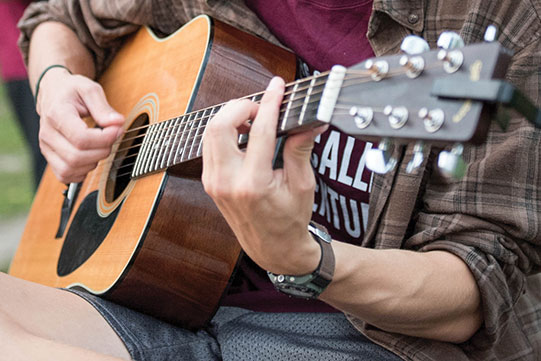
“Clif Builder’s Bars, coffee, my Nalgene bottle, sunscreen, Noah playing his guitar, my Buff, and long talks in the canoe with Emily about my future.” —Izzie Smith

The voyage as art
To share those connections with the Augsburg community, the crew collaborated with Minneapolis-based graphic design and digital arts professors and students to develop an exhibit featuring sights, sounds, textures, emotions, and artifacts from the trip, including one of the canoes that flew the Augsburg College flag.
Assistant professor of art Chris Houltberg and visiting instructor Julie Longo challenged students in three different courses to create a unified experience on campus that captured the true essence of the River Semester. Art students video chatted with the crew, conducted extensive research on contemporary river issues, and poured over news articles, social media posts, and the blog, .
Some artists focused on gathering and refining content for the interactive display while others developed the exhibit’s look and feel, devising its color palette, graphic elements, and typography scheme. Their semester-long partnership culminated in a display featuring a robust timeline, heartfelt journal entries, dynamic photos, and several other elements.
The exhibit, displayed at the Christensen Center Student Art Gallery, built upon previous collaborations between Underhill and the design faculty. Last spring, they created “Shaping Peace,” an interdisciplinary collaboration among 128 students and six faculty members to visualize and exchange ideas about Nobel Peace Prize laureates.
“We are primarily interested in how design can be used as a catalyst for change,” Houltberg said. “The ideas and issues the River Semester students encountered are really important to our world. We set out to create a platform that encouraged dialogue around the important ideas and issues the participants experienced.”
Memories keep rollin’ along
The next leg of this journey: The documentary. Taylor produced several short videos chronicling the trip, which are at , and he’s looking forward to sharing the experience through his forthcoming feature-length film. For now, the River Semester crew continues to process the issues they know and to reflect upon their moments together: rows of sleeping bags dotting the shore as they looked up at an ebony sky studded with millions of heavenly diamonds; waking at 3 a.m. to paddle from darkness to dawn; and swaying in hammocks tied to the tall willow trees of remote river islands.
So, if you see members of this motley crew sleeping outside, don’t judge. They’re just longing to be back on the water, where they grew stronger and a bit wiser, having realized that the issues gripping the Mississippi River are as sophisticated as its ecosystems. That enlightenment has influenced the way they now see the world, with varying shades of compromise and understanding. They reenter their lives with renewed purpose, fueled by an empowering sense of community, the ability to adapt, and the ache for life’s next adventure.
From trickling headwaters to theÌýwide and mighty ocean
River Semester participants share memorable events along the river
Beginning in 2003, Augsburg College Associate Professor Joe Underhill began incorporating short Mississippi River trips—three-, five-, and 10-day excursions—into his environmental politics curriculum. He first presented the idea of a semester-long trip to College leadership in 2012, and then three years of logistical discussions and planning followed. This past fall, Underhill and biology instructor Thorpe Halloran shoved off from St. Paul with 12 students, two guides, and a teaching assistant. Here are a few highlights from their journey.
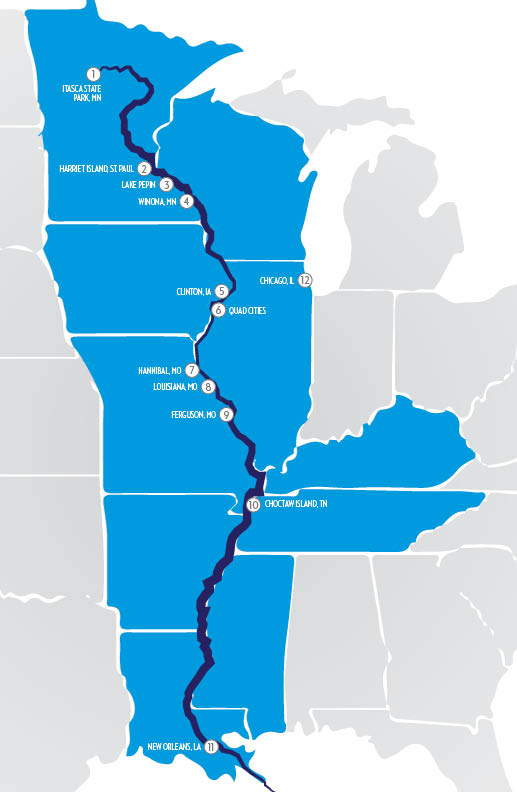 1. Aug. 28-30:ÌýHeld an orientation at the Mississippi River headwaters to introduce courses, review canoeing and water safety basics, and discuss topics such as American Indians’ perspectives on the environment and sustainability.
2. Sept. 1: Chris Coleman, mayor of St. Paul, joined nearly 100 Auggies, family members, and high school students at the launch of the nation’s first-ever River Semester. Dozens of attendees paddled in a flotilla of 24-foot voyageur canoes to South St. Paul.
3. Sept. 5-7: Studied the water quality and impact of farming, including increased sediment load on the river. Sampled water alongside fisheries biologists with the Minnesota Department of Natural Resources.
“Without a current and with a brutal head wind, paddling Lake Pepin was probably one of our most challenging days.” —Lily Moloney ’15
[Web extra] Sept. 10-11: Swan Island near Wabasha, Minnesota: The crew’s first extended stay on a relatively wild site, known as Weaver Bottoms. Ironically, it’s an artificial island constructed by the Army Corps of Engineers to recreate islands that were lost when dams were built.
4. Sept. 12-17: Joined faculty and students from Winona State University for stream ecology labs and discussion on the impact of the lock and dam system.
[Web extra] Sept. 22-24: Effigy Mounds National Monument, Iowa: Explored this picturesque site featuring more than 200 prehistoric earthen mounds, including some shaped like animals. These ceremonial and burial sites, built by American Indians hundreds of years ago, remain sacred to more than 20 culturally associated tribes.
5. Oct. 3: A rough paddle through the pool above Lock and Dam No. 13, one of the widest pools on the upper river. The crew struggled through fierce winds to avoid submerged tree stumps left over from before the dam was built. One of the canoes sustained a bad crack, which the crew repaired at camp.
6. Oct. 7-10: Met with local farmers and a nonprofit environmental group that organizes river cleanups, tree plantings, and other conservation efforts. The crew also engaged a field lab with Reuben Heine, geography professor at Augustana College in Illinois.
7. Oct. 20-21: When the crew paddled into author Mark Twain’s hometown, Izzie Smith ’18 began to suffer from stomach pain. By midnight, she had been diagnosed with appendicitis, and the next morning she had surgery. Two weeks later, Smith rejoined the group in Memphis. Even with all the excitement, the team still engaged in a lively discussion about Huck Finn and literary figures born along the Mississippi.
8. Oct. 29: The last morning of their journey on the upper river, the crew woke up at 3 a.m. to paddle for a few hours in the dark to catch the sun rise over the river. They ended their sunrise paddle on the Mississippi’s banks north of St. Louis, from which vans shuttled the crew past the Chain of Rocks, an exposure of bedrock in the Cuivre River.
9. Nov. 2: As part of Underhill’s course, Democracy in the American Heartland, students traveled to the Michael Brown Memorial—the site of the August 2014 shooting death of a black teenager by a white policeman, which prompted national commentary on racial discrimination and gun control. President Paul Pribbenow joined the group for a tour through the city and discussions with residents.
“Standing at that memorial in the middle of the road was a deeply unsettling experience—there was no way it could or should have been otherwise.” —President Paul Pribbenow
[Web extra] Nov. 7-9: Memphis, Tennessee: Studied music, history, and food before meeting with researchers from the Mississippi River Project at the University of Memphis.
10. Nov. 16: The team paddled past expansive sandbars and islands full of wildlife at the confluence of the Mississippi and Arkansas rivers. Waters in this area can rise and fall as much as 70 feet and swirl around canoes.Ìý
[Web extra] Nov. 22-23: Natchez, Mississippi: Studied bayou country and industry while exploring the Atchafalaya River.
11. Nov. 26: Thanksgiving in New Orleans: The crew enjoyed an abundance of fried turkey and comforting side dishes at their hostel as they visited with fellow travelers from more than a dozen countries.
[Web extra] Dec. 2-7: Gulf of Mexico: Field research studying marine biology and estuarine ecology with the Louisiana Universities Marine Consortium.
12. Dec. 11: Travel by train to Chicago.
“The train back to Chicago was spent doing a lot of work on our finals, but it was also a time to reflect on everything we experienced on the trip.” —Blair Stewig ’18
[Web extra] Dec. 12-13: Chicago: Studied urban waterfront developments, sustainability, and arts in the Second City.
13. Dec. 14-15 The crew traveled by train from Chicago to the Twin Cities and joined in a “good-bye” hug upon arrival at Union Depot in St. Paul.
ONLINE EXCLUSIVE: As part of the River Semester welcome back celebration, Augsburg graphic design and typography students created an interactive gallery exhibit chronicling the voyage.
You Might Also Like

Playing it forward
- on March 23, 2016