

Each summer, undergraduate students at Augsburg College work directly with faculty mentors to complete individually designed research projects and creative activities. Auggies seeking to enhance their education gain rich, hands-on experience by participating in research opportunities sponsored by the College, funded through grants and private gifts, or offered through federal programs.
Students from all disciplines can participate in summer research. This year, their topics included designing a tool to sample motor vehicle pollution; examining immigrants鈥� influence in community organizations and politics; cloning and characterization of Daphnia magna, a water flea; and analyzing the effects of the No Child Left Behind Act on Minneapolis youth, among many others.
During the research process, students often use specialized materials and technologies, investigate complex and specific concepts, and explore existing scholarship and literature.
Here are the answers to the question, “What is it?”
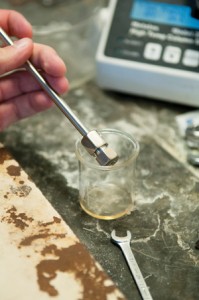 Q: What is it?
A: A column that contains a catalyst and through which a stream of reactants move. Reactants are substances that undergo change during a chemical reaction, and 鈥渇low chemistry鈥� is a process that gets its name from the movement of these materials.
Alan Medina-Gonzalez 鈥�16
Major: Chemistry, Minors: Biology and Mathematics
Research mentors: Z. Vivian Feng, associate professor of chemistry; and Michael Wentzel, assistant professor of chemistry
Alan Medina-Gonzalez 鈥�16 chose to participate in summer research because it granted him the opportunity to spend more time in the lab optimizing a chemical reaction, which is a fun鈥攁lbeit time-consuming鈥攑uzzle he enjoys solving. 鈥淚 wanted to see what it was like to work on a project all day long versus only going into the lab four hours per week as part of a class,鈥� he said.
Medina-Gonzalez鈥檚 research involved setting up chemical reactions using flow chemistry鈥攁 process that helps make reactions more 鈥済reen鈥� by allowing chemists to lessen waste generation and to improve energy efficiency and safety. His research goal included producing a variety of molecules, including acetaminophen鈥攖he primary active ingredient in Tylenol and other medicines鈥攖o demonstrate the uses of flow chemistry in the pharmaceutical industry.聽
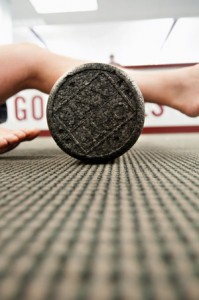 Q: What is it?
A: A foam roller, a tool that breaks up fibrous tissue in order to increase muscle elasticity and circulation flow.
Briana Felton 鈥�14
Major: Exercise Science, Minor: Psychology
Research mentors: David Barrett, assistant professor of health, physical education, and exercise science; and Tony Clapp, associate professor of health, physical education, and exercise science
Briana Felton 鈥�14 chose a summer research project that will help to prepare her for the dream of attending graduate school to study physical therapy. Felton is a member of the Augsburg women鈥檚 soccer team, and she loves sports and fitness. Athletes commonly use a foam roller on their muscles for self-myofascial release鈥攁 process that applies pressure to trigger points within muscle tissue and is thought to cause the tissue to relax and become more flexible.聽
Although the use of foam rollers has become a common practice in therapy and fitness centers, few peer-reviewed studies have examined its effectiveness. For Felton鈥檚 research project, she conducted a study in which middle-aged adult males participated in an exercise program utilizing foam rollers. Felton then assessed the study participants鈥� balance and functional movement patterns using industry-standard tests to see whether their scores improved over the course of the study. Higher scores have been shown to correlate with a person鈥檚 decreased risk of injury.聽
The results:
Felton鈥檚 study found that the Functional Movement Screen, the聽assessment used to gather comparison data for individuals鈥� fitness聽before and after the foam-rolling regimen, had a significant increase聽in its composite scores. On average, scores from pre- to post-test聽increased by 2.06 points out of 21. Although the composite scores聽illustrated a significant increase, not all of the individual tests聽showed such an increase. Study participants were also asked to聽self-evaluate perceived pain, and there was no significant increase聽for any of the 10 survey questions.
In the future, Felton is interested in replicating this study with聽females in the same age group as her summer 2014 study, which was聽limited to males. She also is considering whether selecting a聽population with more known deficits and, therefore, more room to聽improve could influence the research results.
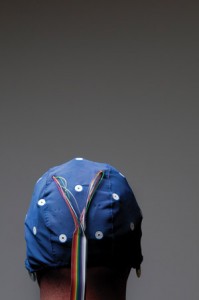 Q: What is it?
A: An electroencephalogram (EEG) recording cap, which is used to capture the brain鈥檚 electrical activity while at rest or engaged in mental activity.
Brad Marcy 鈥�15
Major: Biopsychology, Minor: Chemistry
Research mentor: Henry Yoon, assistant professor聽of psychology
Research conducted on substance use disorders often extends to either the biological or the behavioral aspects of addiction. This summer, Brad Marcy 鈥�15 took on the challenge of combining both of these aspects into a single study incorporating behavioral information鈥攊n this case, a person鈥檚 age of first alcoholic drink (AFD)鈥攁nd biological data, which was derived from brain patterns collected through EEG scans.
Marcy and other Augsburg psychology students gathered data by working with student volunteers, including those in the College鈥檚 StepUP庐 program, which serves students who are in recovery from addiction. Marcy鈥檚 research project involved processing and analyzing participants鈥� EEG data in order to identify telltale signs of being at biological or genetic risk for dependence in these brainwave patterns. He then examined whether an association exists between this biological information and AFD. By evaluating these variables, Marcy can later assess their usefulness in refining the diagnosis of substance misuse.
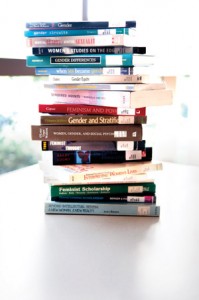 Q: What is it?
A: The examination of journal articles, images, and academic texts鈥攊llustrated here鈥攁re key aspects of student researchers鈥� literature review process. A literature review discusses published information in a particular subject area.
Awale Osman 鈥�15
Major: Communication Studies, Minor: Women鈥檚 Studies
Research mentor: Adriane Brown, assistant professor of women鈥檚 studies
鈥淚鈥檝e always wanted to be a teacher,鈥� said Awale Osman 鈥�15, a McNair research scholar whose project almost perfectly aligned with his desired career path. Osman began his undergraduate education at a community college before transferring to Augsburg, and his research project involved examining the establishment and evolution of women鈥檚 studies, the emergence of gender and masculinity studies, and current dialogue regarding the field. This work allowed him to combine his interests in communications and women鈥檚 studies into a project that enhanced his academic skills.
Osman would like to return to a community college one day鈥攖his time as a professor instead of as a student. Osman chose his research topic in order to establish a foundation in the research he hopes will be incorporated in a future doctoral program that will, eventually, lead to a teaching role in higher education. 鈥淚 realize I have to be grounded to be successful in my track,鈥� he said. 鈥淪o, I鈥檓 going for it.鈥�
 Q: What is it?
A: The Bengali pronoun 鈥�膾迟腻,鈥� which is similar to the English pronoun 鈥渋t.鈥�
Priti Bhowmik 鈥�15 and Bram Oosterlee 鈥�16
Majors: Computer Science
Research mentor: Shana Watters, associate professor of computer science
As international students, Priti Bhowmik 鈥�15 and Bram Oosterlee 鈥�16 were attracted to research linked with the official languages of their home countries. In 2011, Bhowmik left Bangladesh to attend Augsburg, and she seized the opportunity to use her background in the Bengali language in combination with her computer science major. Her research project fell in the field of computational linguistics鈥攁 branch of linguistics in which computer science techniques are applied to the analysis of language and speech. She explored whether the pronoun 鈥�膾迟腻鈥� has the same cognitive status as the English pronoun 鈥渋t.鈥� That is, whether a Bengali speaker, in determining what 膾迟腻 refers to in a sentence, uses his or her short-term memory in the same manner that an English speaker does when determining what the word 鈥渋t鈥� refers to.
Oosterlee, a student from the Netherlands, performed a similar study by examining the cognitive status of the Dutch pronoun 鈥渉et.鈥� Bhowmik and Oosterlee鈥檚 work ultimately will contribute to developing systems that enhance how computers extract information, summarize text, and translate language. One example of the usefulness of these processes is that they increase the likelihood of returning accurate content descriptions when doctors use digital medical reference materials to find information that pertains specifically to a disorder.
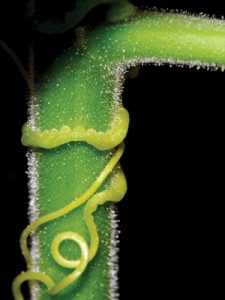 Q: What is it?
A: The parasitic plant dodder聽(Cuscuta pentagona) attached to a host plant from which it acquires all its water and nutrients.
Lucy Bukowski 鈥�16
Major: Biology, Minor: Environmental Studies
Research mentor: Bill Capman, associate professor of biology
Augsburg College students have studied the interactions between dodder and its host plants since 2008, and this summer Lucy Bukowski 鈥�16 worked on an experiment testing the hypothesis that a decline in the health of the host plant triggers the dodder to flower. Bukowski鈥檚 project benefitted from the help of a plant pathologist at the University of Minnesota-Twin Cities who offered greenhouse space, thus providing a larger growing area and better growing conditions for Bukowski鈥檚 research.
Online-exclusive content: More about the dodder project
Bill Capman has mentored Augsburg College students conducting hands-on research using the聽dodder plant both to fulfill their undergraduate coursework and to gain experience through the聽College鈥檚 co-curricular programs. In Bukowski鈥檚 case, spending the summer working on an individually tailored project offered a structured yet challenging opportunity to gain exposure聽to the steps comprising sophisticated academic research, which include conducting a literature聽review, collecting and analyzing data, presenting key project takeaways to a live audience in a聽setting that simulates a research conference, and more.
Bukowski鈥檚 project聽built upon聽research by a series of previous Augsburg College students during the past 10 years whose work聽focused primarily on patterns of host plant resistance to dodder. Faculty members often lead subject-specific research聽that incorporates new students year after year, adding depth and longevity to the investigation聽while also allowing students to contribute to聽a body of聽research聽that is bigger than聽their individual聽project.
Anika Clark 鈥�14 took part in research advised by Capman during the summer of 2013, and she聽said her experience was enhanced through the contributions made by preceding students.
鈥淸By]聽looking at the methods of previous research done at Augsburg, I could optimize the methods for聽my specific question,鈥� she said.
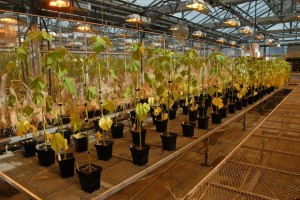
Clark鈥檚 research spurred a unique鈥攁nd fortunate鈥攐pportunity for Bukowski. Through the聽research presentation at the conclusion of Clark鈥檚 2013 project, a plant pathologist from the聽University of Minnesota聽became intrigued by the dodder research聽at Augsburg. He聽invited Capman to give a research seminar at the University of Minnesota on the dodder work and聽then聽offered聽the use of some of his聽greenhouse聽space as an improved setting in which to grow dodder and its host plant, velvetleaf, during the聽summer of 2014.
鈥淟ucy聽got聽to work聽side-by-side with really big science,鈥� said Capman, explaining that the聽greenhouse is also used for research on wheat rust, soybean aphids, and other projects linked to聽global food security.
Access to a bigger聽and more uniform growing聽space allowed Bukowski and Capman to implement a large-scale project for聽the first time,聽building on聽an already fascinating聽series of studies.
Bukowski and Clark said they plan to attend graduate school in the future and appreciate the聽ways in which on-campus summer research at Augsburg has helped to prepare them for the next聽phase in their education.
鈥淧rior to [the dodder] project, I had no research experience,鈥� said Clark. 鈥淚 am so lucky that鈥聽gained a sense of confidence regarding my abilities.鈥�
Bukowski hopes her first research experience will lead to additional opportunities prior to聽her graduation while also enhancing her graduate school applications and preparedness for its聽rigorous workload.
鈥淭his project shows I can work semi-independently and successfully on research,鈥� she said. 鈥淚聽know it will open up more doors for me in the future.鈥�
Experiential education through undergraduate research
One key way Augsburg College delivers on its commitment to experiential education is through undergraduate research projects in which Auggies employ their talents and passions. On campus, these projects are funded through several sources, including Augsburg鈥檚 Office of Undergraduate Research and Graduate Opportunity (URGO), National Science Foundation and corporate grants, private donations, and the McNair Scholars program鈥攁 federal TRIO program funded by the U.S. Department of Education and designed to increase graduate degree attainment by students who are first-generation, low-income, and/or members of groups underrepresented in graduate education.
You Might Also Like

Sideline support
- on December 02, 2015
Faithful and relevant
- on July 22, 2014