

BY WENDI WHEELER ’06 AND REBECCA JOHN ’13 MBA
“To prepare Americans for the jobs of the future … we have to out-educate the world.” (whitehouse.gov)
The programs in Augsburg’s Education Department prepare teachers—at both the undergraduate and graduate levels—to meet our national education challenge.
The U.S. government recognizes that “the strength of the American economy is inextricably linked to the strength of [our] education system,” which means “America’s ability to compete begins each day, in classrooms across the nation.”
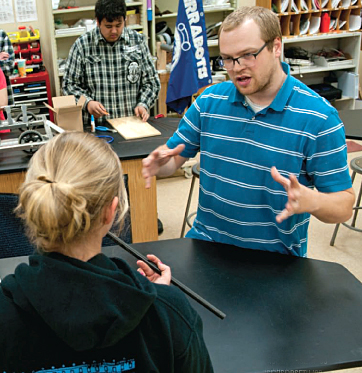
Auggie teachers and education alumni are leading these classrooms, improving education outcomes, and shaping our future. They are igniting student interest in math and science, educating an increasingly diverse youth population, bringing global perspectives and learning into the classroom, and leveraging new technologies and teaching practices to enhance learning. The following are just a few examples of the ways Auggie teachers and education alumni are leading the advancement of education in our schools.
Cutting-edge science research for middle and high school students
When Dan Forseth ’08 was a student at Augsburg, he spent many hours in the lab with associate professor of physics Ben Stottrup. It was Stottrup, he said, who helped him realize he wanted to be a teacher. “He taught me how to make things work with what you have,” Forseth said.
Today Forseth uses that lesson in his own classroom to excite students about science and to inspire the next generation of teachers. He teaches biology, physical science, and robotics at St. Paul Preparatory School, an international college-preparation program in St. Paul. He said he enjoys teaching because he loves the transformation when students grasp a diffi cult concept after struggling with it. “When they get it, seeing that light bulb turn on for them is very exciting.”
During the summer of 2012, Forseth was one of six teachers who participated in a research program at Augsburg funded by a grant from the Margaret A. Cargill Foundation. The program paired Augsburg undergraduate science education students studying to be secondary teachers with current science teachers. The teams conducted college-level research, which was supervised by Augsburg faculty, and developed curricula to adapt science projects for middle and secondary school classrooms.
The Augsburg education students in the program learned about the practical realities of teaching from their interactions with current teachers, Forseth said. “And teachers like me were revitalized by the opportunity to work in new labs and develop new and different topics for our classes.”
Along with engaging in scientific research, participants had opportunities to expand their scientific professional networks through conversations and workshops with scientists in the workplace and college science faculty, said Tracy Bibelnieks, Augsburg associate professor of mathematics and director of the Margaret A. Cargill Foundation grant.
“Feedback from last year’s participants was very positive,” she said. “We are looking forward to building on that experience to continue developing ways that cutting-edge research and engaging experiences can be integrated into 9th- through 12th-grade STEM (science, technology, engineering, and mathematics) classrooms.”
Forseth will participate in the program again this summer, working with Augsburg faculty to create a website to share materials produced in the program with 9th- to 12th-grade STEM teachers across the state. “This program provides an opportunity for Augsburg students pursuing secondary STEM licensure to learn from experienced science teachers and helps current teachers integrate more research and authentic learning experiences into their classrooms,” he said.
Teaching in a diverse world
When Will Ruffin ’13 MAE moved from California to North Dakota to attend college, he left his little brother behind. “He struggled in school. I was the smart older brother who wasn’t there for him, and that always bothered me,” Ruffin said. It’s the memory of leaving his brother that today drives Ruffin to make a personal connection with each of his students.
For Kassie Benjamin-Ficken ’12, it’s her ability to relate to the experiences of first-generation and minority-culture students that has strengthened her connections with her students. “As a first generation student, I think it’s easier for me to explain to my students why it’s important to get an education,” she said.
Ruffin and Benjamin-Ficken are examples of Auggie teachers working in increasingly multicultural communities—where the ability to connect with students of diverse backgrounds is critical to student success.
Despite his passion for teaching, Ruffin didn’t begin his career in education. He first completed a bachelor’s and a master’s degree in business and began working for a retail company in southern Minnesota. Then one of his customers—a teacher—asked if Ruffin would volunteer at his school because the teacher wanted a strong, black, male role model to work with his students. “There was just something about being with kids that hooked me,” Ruffin said, “and I fell in love with teaching.”
Ruffin became a substitute teacher and eventually was teaching full time, so he decided to attend Augsburg to pursue a master’s degree in education. For the past five years, he has been teaching fi fth grade at Riverside Central Elementary in Rochester, Minn.
For many students, Ruffin is the first black teacher and the first male teacher they have had, so he takes seriously his responsibility to be a role model in a community that is increasingly more ethnically and culturally diverse. Judging by the drawings and awards posted by students on his classroom walls, and by the former students who often stop in at Riverside to visit, Ruffin is making a difference in students’ lives.
As a student himself, Ruffin said, he was quiet and seldom participated in class discussions. As a teacher and leader, however, he’s learned that his voice is important. “I know I have a lot to share, and I can enrich others’ experiences through my own,” he said. “I can’t be a leader and be silent. I have a perspective that too often is lost or overlooked, and I need to share that.”
Benjamin-Ficken, a member of the Mille Lacs Band of Ojibwe, also embraces the opportunity to bring her cultural perspective into the classroom. “My culture teaches that you are on this Earth to help others,” she said. “Education is how I can make a difference.”
At Augsburg, Benjamin-Ficken double majored in elementary education and math. This July, she completed her first year at Tatanka Academy in Minneapolis, where 13 of her 14 first-grade students were Native American.
In working with students from minority populations, Benjamin-Ficken strives to instill in them the belief that they can—and should—excel in school, especially in STEM fields where populations of color and females are significantly underrepresented. For example, this past spring, Benjamin-Ficken celebrated “Pi Day” (which falls on March 14, or 3/14, representing the first three digits in the mathematical constant, pi) with her students. A self-professed “math nerd,” Benjamin-Ficken believes that these types of classroom experiences will help her students see math as a subject they can succeed in and, potentially, choose to pursue in their lives.
Augsburg’s focus on urban education and teaching in a multicultural classroom were an important part of her educational experience, Benjamin-Ficken said. “My education studies at Augsburg really taught me to reflect,” she said. “Taking time to ask what went well [in class], what didn’t, and whether you reached every student—that’s what makes you a better teacher.”
Since 2004, five Augsburg education graduates have received the prestigious Milken Award for Excellence in Teaching. This award provides public recognition and financial awards to elementary and secondary education professionals. Only 30 Milken Awards are given annually across the United States.
Bringing global issues and perspectives into the classroom
Teaching and traveling are more than passions for Kate Woolever ’11—they are vital to her own education as a citizen of the world. As a studio art and education major at Augsburg, Woolever combined her interests into a career that today allows her to continue her own education and to provide meaningful learning experiences for her students.
Woolever’s mother, father, and brother are teachers, so it’s no surprise that she also chose to become a teacher. “Teaching is completely a part of my life,” she said. “For me it’s about service to others.”
Woolever came to Augsburg because she wanted to teach in an inner city or international school, and she felt Augsburg’s program would best prepare her for that career. As a student, Woolever took advantage of opportunities to study abroad through the College’s Center for Global Education. She studied in Namibia, Thailand, and Ghana, where she completed her student teaching. She said she has always “traveled with a purpose,” using travel to learn about others by experiencing their lives firsthand.
After she became an art teacher at St. Paul Preparatory School in the Twin Cities, Woolever had another opportunity to travel and teach abroad. She was one of five U.S. teachers selected to participate in a program through World Savvy and the U.S. State Department. With 30 U.S. high school students, she studied the environmental, social, economic, and political impacts of climate change in Bangladesh. The group spent one month living with host families while participating with Bangladeshi students in research and service projects.
Woolever lived in the Rayer Bazar slum located on the edge of the capital city of Dhaka—the fastest growing city in the world. She interviewed and photographed climate refugees who had moved to the city from outlying areas because the flooded coastal lands are uninhabitable and the soil is too saline-contaminated to support crops.
“These climate refugees now live in indescribable squalor,” Woolever said. “There are a thousand people per square kilometer living in Rayer Bazar; 100 people sharing three open gas flames for cooking and a single squat toilet.” This experience, Woolever said, made her more aware of the global effects of climate change and emphasized the importance of spreading the word. “The guilt I felt—coming from my bountiful country and witnessing these people’s atrocious living conditions—constantly tugged at me, and I needed to find a way to respond.”
One way Woolever responded was to turn her photos and stories into a traveling exhibit, which she hopes to show at numerous venues across the state. This past March, her work was displayed in Augsburg’s student art gallery in Old Main; the exhibit then was shown in the Pelican Rapids (Minn.) Library during May and June.
Because of her experiences in Rayer Bazar, Woolever also is committed to finding ways to incorporate real-world issues into her classroom. The Bangladeshi trip was a stark lesson in how much we consume and how wasteful we are as a culture, Woolever said. Education, at the very least, “is not something we should take for granted.”
In 2009, the Margaret A. Cargill Foundation awarded Augsburg more than $400,000 in support of its teacher preparation programming. Augsburg was one of only four Minnesota colleges receiving these grant funds. Augsburg also participates in the Network for Excellence in Teaching (NExT) and is one of six private colleges in the Twin Cities working to improve teacher education through the Twin Cities Teacher Collaborative (TC2), made possible by major funding from the Bush Foundation.
The College also gives education majors an opportunity to engage elementary school children in the sciences through Girls in Engineering, Math, and Science (GEMS) and Guys in Science and Engineering (GISE), two summer programs held on the campus.
Flipped classrooms: Creating student focused learning environments
Most of the time, a noisy middle school classroom doesn’t seem like a productive learning environment. But, when the classroom is “flipped,” noise is a sign that students are engaged in the learning process and working constructively with each other.
Tara Martinson ’09 MAE leads a lively seventh-grade pre-algebra class at Central Middle School in Eden Prairie, Minn. The reason for all the activity is that Martinson uses the flipped learning model of instruction. With this particular method, students listen to an online lecture at home and complete a “note sheet”—a structured note-taking guide—on the lesson. The next day in class, students spend the majority of their time in “hands-on” learning exercises, working out practice problems and completing small group activities. Students can ask each other for help and are required to check their work with Martinson.
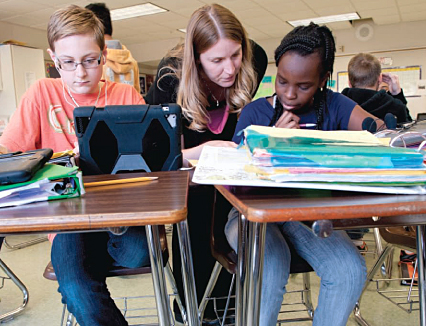
Martinson, who has taught middle school math for five years, flipped her classes in January 2012 after learning about the method at the 2011 Education Technology Conference hosted by TIES, the St. Paul-based education technology training organization. During the winter break, she recorded lectures and set up the resources for her classes and then introduced the model to her students at the start of the new term.
With research support from George Mason University and sponsored by Pearson, the Flipped Learning Network this summer released the first comprehensive literature review on the flipped learning model.
With flipped learning, Martinson said her students are more engaged because the responsibility for learning the material rests with them. “Before [flipping the class format], I typically would lecture for 35 minutes, and the students would have the last 10 minutes of class to start their assignment,” Martinson said. “Then, if a student got lost, they would just shut down. Now there is a much higher level of engagement and retention.”
Flipped learning changes education from a teacher-centered classroom to a student-focused learning environment, said Kari Arfstrom ’89, executive director of the Flipped Learning Network, a nonprofit organization dedicated to providing educators with the knowledge, skills, and resources to successfully implement flipped learning.
“When I went to school,” Arfstrom said, “it was the teacher who was imparting information to the student. Now the students are leading and determining what they need.” This model makes students more accountable because the teacher has an opportunity to talk with them every day, Arfstrom said.
With flipped learning, teacher interaction with students increases dramatically, said Taylor Pettis ’03, ’09 MAE, senior manager of marketing communications at Minneapolis-based Sophia Learning, which has worked with thousands of teachers to create flipped classrooms. “One of the teachers we worked with said his feet hurt after class because he’s walking up and down the aisles so much more.”
Teachers also have a greater opportunity to provide differentiated instruction to each student when they use a flipped learning model, Pettis said. This customized, student-centered attention leads to improved student learning. “Eighty-five percent of teachers we work with report improved grades in their flipped classes.”
For Martinson, the benefits go beyond improved performance in class. In the flipped environment, she said, students learn social skills, relationship building, and self-advocacy—abilities that will serve them well in high school, in college, and beyond.
In May, the State of Minnesota approved legislation granting Augsburg College nearly $400,000 over the next two years to launch the East African teacher preparation program. The new Augsburg EAST (East African Students to Teachers) initiative will provide scholarships, academic support, and service learning opportunities for East African students who are education majors at Augsburg’s Minneapolis and Rochester campuses.
The number of East African students in K-12 public schools is growing in many communities throughout Minnesota. School systems are challenged to meet the needs of these students, many of whom are the first in their families to receive education in the United States. Augsburg’s strong relationships with the Somali and East African communities and its successful record of teaching East African education majors, in both Minneapolis and Rochester, make it uniquely qualified to lead this initiative.
Every year, more than 600 Auggies are enrolled in education degree programs at Augsburg’s Minneapolis and Rochester campuses. About 250 of those students are undergraduates—of all ages—pursuing bachelor’s degrees in education. The remaining 350 are enrolled in the College’s Master of Arts in Education program, which provides training for professionals to begin a career in teaching or for current teachers to obtain additional licenses or endorsements. Every day, these Auggie educators—both in and outside of the classroom—are preparing our children to live and grow in our increasingly diverse, globally connected, and technologically sophisticated world. They are, literally, shaping our future potential.
Online exclusive: Bringing global issues and perspectives into the classroom
Teaching and traveling are more than passions for Kate Woolever ’11—they are vital to her own education as a citizen of the world. Here Woolever reflects on a trip to Bangladesh where she was one of five U.S. teachers selected to study the environmental, social, economic, and political impacts of climate change.
, a set on Flickr.
I found it was my curiosity that brought me to this country removed from the global mainstream in so many ways. While I was there I experienced a whirlwind of emotions, making it hard to share what I saw without the imagery of photos. I often ask others to imagine the realities of such a densely populated country; a country the size of Iowa yet half of our country’s population.
Living in a slum called Rayer Bazar located in Dhaka – the fastest growing city in the world – is a challenge to describe. So crowded…so crowded that nearly every park, footpath, and road median has been colonized. The mass influx of “climate refugees” is due to citizens in the outlying areas fleeing their flooded coastal lands left uninhabitable or too saline-contaminated to support crops. They brought their families and stories, searching for employment and safety.
During the days, I walked through the streets of Rayer Bazar interviewing climate refugees with the aid of a translator. The majority longed to go back to their farmlands, which sadly had been transformed into flood plains. These transplants now lived in indescribable squalor; slums of a thousand people per square kilometer. Cooking for 100 people was shared over three open gas flames along with one squat toilet for a public bathroom. Children filled the shadows yet their access to education was nonexistent. The guilt and the need-to-respond that I felt (coming from my bountiful country) constantly tugged at me.
In spite of the overwhelming poverty, Bangladesh is the home of some of the most resilient people. They watch… as sea levels rise, salinity infects their coastal aquifers, and rivers consume their lands and as cyclones batter their coast with increasing intensity. All these changes have been associated with global climate changes.
I learned much from these wonderful people. Instead of giving up, many of them invested in ways to adapt. Their survival measures could become our lessons lest we ignore the necessary commitments for change. The long-term risks could bring significant degradation to our lifestyles someday soon…if not the challenge to our world to survive.
You Might Also Like

Lacrosse team maps new ground in women’s athletics
- on August 14, 2013
Hybrid learning
- on August 14, 2013