

By Wendi Wheeler ’06
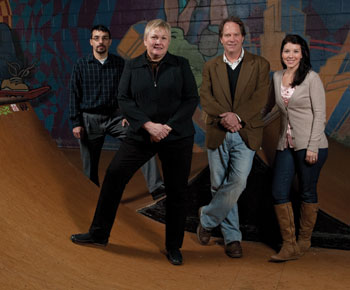 Augsburg MBA students completed an assignment and got much more than a grade out of it. They got some great coffee and the good feeling that comes from giving back.
Wouldn鈥檛 it be great if you could complete a project for your graduate school class, earn a passing grade, and help someone else in the process? That is what happened for a group of Augsburg MBA students. Their management consulting capstone鈥攁n online marketing research project鈥攈as the potential to help one incredible organization and at least 1,500 young people in Minneapolis.
When it came time for Lynn Harris, Darren Chaloner, and Kelly Ambourn to choose an organization to work with for their MBA project, they wanted to move beyond the obvious choices. Harris says they wanted to help a local social enterprise, so she did a bit of research and found CityKid Java.
CityKid Java is a local for-profit coffee company located off Lake Street in Minneapolis鈥� Phillips and Central neighborhoods. Every dollar of their profit is returned to the community, specifically to their non-profit partner, the Urban Ventures Leadership Foundation鈥檚 youth programs. Urban Ventures鈥� youth programs provide mentoring, athletic teams, camps, leadership experience, and after-school programs for at-risk inner city youth. In 2010, CityKid Java gave $80,000 to Urban Ventures.
The team worked closely with Mark- Peter Lundquist, CityKid鈥檚 founder and vice president of Urban Ventures; Jenifer Hagness, general manager of CityKid; and board member Joyce Hansen. They asked what CityKid needed, outlined the deliverables, and went to work.
Hagness says the team provided marketing research and recommended tools and resources that CityKid could begin using immediately. 鈥淲hen they came to us, we really gave them a blank slate in terms of the website. We thought we knew some things about our market and our customers, but they really gave us some great tools and resources,鈥� Hagness says. Ultimately the team developed a Web 2.0 marketing plan including a social media strategy for increasing traffic and sales and building awareness on the CityKid website.
Harris says she was excited to see how their ideas could help the organization. CityKid took the team鈥檚 information, moved ahead with their recommendations, and even dedicated an employee as their 鈥渃hief listening officer鈥� to focus on social media. Harris says CityKid also invited the team back to share feedback and the action plan they created based on the team鈥檚 work. 鈥淲e didn鈥檛 see this as just a project,鈥� Harris says. 鈥淲e really took this to heart.鈥�
Throughout the six-month project, Lundquist and Hagness treated the MBA group as a part of their team. 鈥淭hey were very open to questions and made our job a thousand times easier,鈥� says Chaloner. The students were invited to sit in on board meetings and tour Urban Ventures鈥� facilities. Harris says she even joined Lundquist and Hagness at a local roasters 鈥渃upping鈥� experience.
This project, however, had a much greater return on investment for the students. In addition to gaining consulting experience and practical application of marketing research principles, the team had an opportunity to give back to their community. They bought the coffee, of course, but they also shared the story of CityKid Java with their classmates, family, and friends. 鈥淵ou can鈥檛 work with CityKid Java and not tell the story,鈥� Chaloner says.
So that is what Harris and Chaloner have continued to do even after their project was complete鈥攖ell the story of CityKid Java. It鈥檚 one of good coffee for a good cause and the opportunity to get a good grade while working with great people.
Real world setting. Real value.
The courses in the Augsburg MBA program are designed to prepare students with content knowledge and theoretical application. The MBA consulting project puts this into practice in a real-world setting. To be successful in the management consulting project, students have to crystallize their knowledge into the real demands and needs of an existing for-profit, not for- profit, or community service organization鈥攖hey must use their education to be of service to an organization. This is where their learning becomes real, and of real value, in the world.
Students have worked with a broad spectrum of companies from Fortune 100 companies to much smaller organizations such as local theaters and charter schools to individual entrepreneurs starting a company. About half of the recent projects have been with local nonprofits that serve the local communities within Minneapolis and St. Paul.